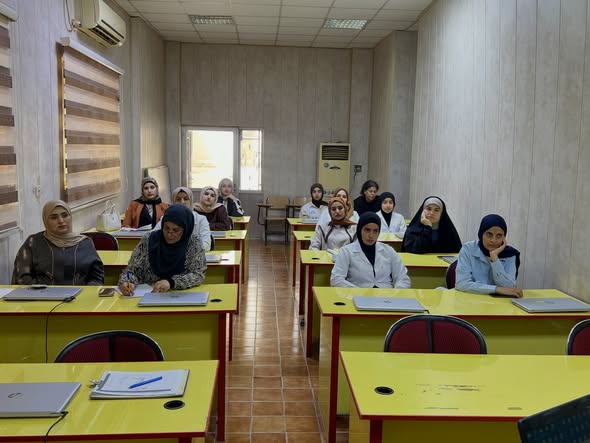
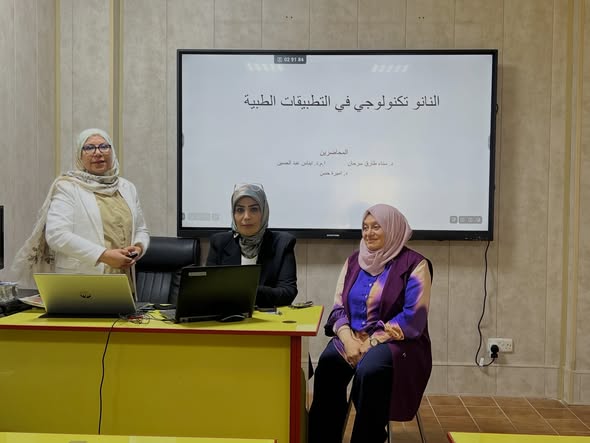
Under the patronage of the Dean of the College of Science for Women, Professor Dr. Sameera Naji Khdim, the Continuing Education Unit, in collaboration with the Department of Chemistry, organized a training course entitled “Nanotechnology: Methods of Nanomaterial Preparation and Its Applications.” The course was presented by Dr. Enas Abdul Hussein, Dr. Sanaa Tariq, and Dr. Ameera Hassan. The event was held in Abdul Hakim Hall and attended by a number of faculty members, staff, and students.
The course aimed to introduce participants to the significance of nanotechnology as one of the most influential modern technologies that has brought about transformative advancements across various fields of life. Nanotechnology is distinguished by its ability to manipulate matter at the atomic and molecular levels, thereby imparting unique properties that are not present in conventional materials at their natural scale. The presenters explained how these scientific advances have enabled researchers to develop materials that are more efficient, cost-effective, and capable of delivering enhanced performance in a wide range of applications.
The course also addressed several major applications of nanotechnology. In the medical field, nanotechnology has facilitated the development of advanced drug-delivery systems and innovative treatments for complex diseases. In the energy sector, it has contributed to improving the efficiency of solar cells and renewable energy technologies. Furthermore, nanotechnology plays a vital role in environmental industries through water purification processes and pollution remediation techniques.
The course emphasized the importance of supporting scientific research in this dynamic and rapidly evolving field and encouraged students and researchers to pursue studies related to nanotechnology due to its pivotal role in promoting sustainable development and keeping pace with global scientific and technological advancements. The event witnessed notable interaction and engagement from participants through discussions and inquiries addressed by the presenters.
This training course contributes directly to the achievement of several United Nations Sustainable Development Goals (SDGs), most notably Goal 3: Good Health and Well-being, through the development of advanced therapeutic technologies; Goal 6: Clean Water and Sanitation, through the enhancement of water purification methods; Goal 7: Affordable and Clean Energy, by improving the efficiency of renewable energy sources; Goal 9: Industry, Innovation and Infrastructure, through the promotion of scientific and technological innovation; and Goal 4: Quality Education, by advancing contemporary knowledge and skills among students and researchers.