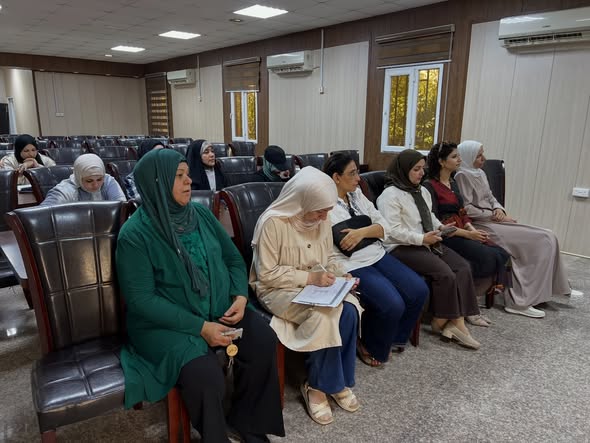
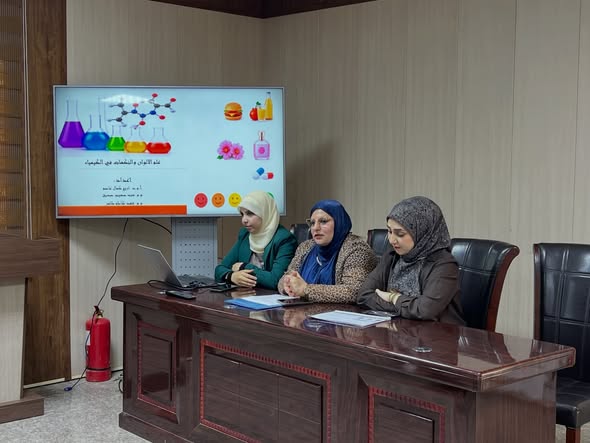
Under the patronage of the Dean of the College of Science for Women, Professor Dr. Sameera Naji khdim, the Continuing Education Unit, in collaboration with the Department of Chemistry, organized a workshop entitled “The Science of Colors and Flavors in Chemistry.” The workshop was presented by Dr. Areej Kamal Issam, Ms. Hind Suhaib Siddiq, and Ms. Shahad Kadhim Tahir. The event was held in the Hospitality Hall and attended by a number of faculty members, employees, and students of the College.
The workshop aimed to explain the scientific basis of colors in chemistry. It highlighted that colors arise from the interaction of matter with visible light, whereby chemical compounds known as chromophores absorb specific wavelengths of light while reflecting others. The presenters explained that color is produced when white light falls upon a substance that absorbs certain wavelengths and reflects the remaining ones; consequently, the color perceived by the human eye is the color of the reflected light.
The workshop further discussed the different types of chemical colorants, including synthetic dyes produced in laboratories and natural colorants extracted from plant-based sources, which are generally considered safer alternatives. A comparison between these categories was presented, emphasizing their sources, characteristics, and applications.
In addition, the workshop addressed the fundamental principles underlying color chemistry, including the role of chromophores and electron transitions in determining the absorption and reflection of light. Practical examples were provided to illustrate these concepts and enhance participants’ understanding.
The workshop aligns with several United Nations Sustainable Development Goals (SDGs). It contributes to Goal 4: Quality Education by promoting scientific knowledge and enhancing chemical awareness. It also supports Goal 3: Good Health and Well-being through increasing understanding of the effects of chemical colors and flavoring agents on human health. Furthermore, the workshop advances Goal 12: Responsible Consumption and Production by encouraging the use of safe substances and natural alternatives, and Goal 9: Industry, Innovation and Infrastructure by strengthening awareness of the industrial applications of chemistry.
The workshop witnessed significant engagement from participants, who actively contributed through questions and discussions. The presenters responded to the inquiries and provided further clarification on the topics addressed during the session.