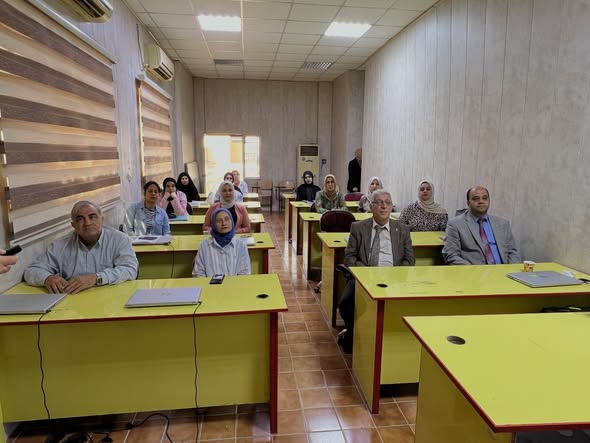
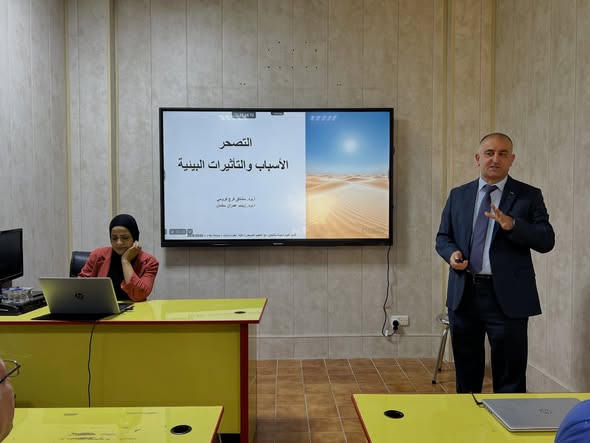
Under the patronage of the Dean of the College of Science for Women, Professor Dr. Sameera Naji Khdim, the Continuing Education Unit, in collaboration with the Department of Biology, organized a workshop entitled “Desertification: Causes and Implications.” The workshop was presented by Dr. Mushtaq Faraj Karoumi and Dr. Zainab Imran Salman and was held in the Abdul Hakim Hall. The event was attended by a number of faculty members, staff, and students.
The workshop introduced the concept of desertification as the degradation of land in arid and semi-arid regions, whereby soil loses its fertility and productive capacity, gradually transforming into barren land resembling a desert. It emphasized that desertification is not merely the expansion of deserts, but also the decline in the quality of agricultural land resulting from both natural and human-induced factors. The principal causes discussed included low rainfall, prolonged drought, rising temperatures, removal of vegetation cover through deforestation, and improper water management and irrigation practices.
The workshop further highlighted the consequences of desertification, including reduced agricultural productivity, soil degradation and loss of fertility, food shortages, and the migration of populations from affected areas. These impacts generate significant environmental, economic, and social challenges. Consequently, desertification is regarded as one of the most serious environmental issues due to its direct effects on land resources, food security, and human well-being.
In addition to defining desertification and examining its causes, the workshop presented several proposed solutions and mitigation measures aimed at reducing the phenomenon. These included improving the management of natural resources, adopting modern irrigation techniques, expanding green spaces, and promoting environmental awareness among members of society.
The workshop witnessed notable engagement from participants through questions, comments, and inquiries, which were addressed by the presenters and organizers of the activity. It is worth noting that the organization of this workshop contributes to the achievement of the United Nations Sustainable Development Goals (SDGs), particularly Goal 15: Life on Land, while also supporting Goal 13: Climate Action.