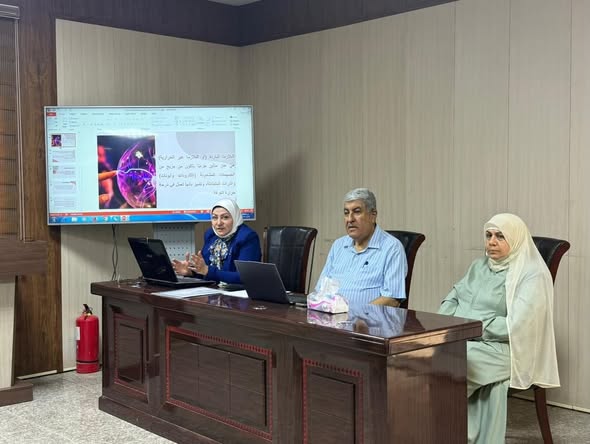
Under the patronage of Professor Dr. Sameera Naji Khdim, Dean of the College of Science for Women, the Continuing Education Unit, in collaboration with the Department of Physics, organized a distinguished scientific workshop entitled “The Application of Cold Plasma in Enhancing the Performance of Gas Sensors.” The workshop was presented by Dr. Ramez Ahmed Al-Ansari, Dr. Ban Hassan Adel, and Dr. Ban Sabah Hamid.
The workshop aimed to introduce the concept of cold plasma as one of the modern branches of plasma physics, highlighting its unique characteristics that distinguish it from conventional plasma. It also reviewed the principles of cold plasma generation and explored its diverse applications in industrial, environmental, and medical fields.
A major focus of the workshop was the application of cold plasma technology to improve the performance of gas sensors. The presenters explained how cold plasma treatment can enhance sensor response, increase sensitivity to the detection of a wide range of gases—particularly toxic gases—and thereby contribute to strengthening environmental monitoring systems and industrial safety measures.
The workshop also discussed advanced surface treatment techniques based on cold plasma and their role in modifying the physical and chemical properties of sensing materials. Such modifications improve sensor efficiency, increase measurement accuracy, and optimize overall device performance. Furthermore, the presenters showcased practical applications and findings from recent scientific studies demonstrating the effectiveness of cold plasma technology in enhancing gas sensor performance and reducing response time. The session also addressed the major challenges facing researchers in this field and explored potential strategies to overcome them.
The workshop concluded by emphasizing the importance of integrating advanced technologies, particularly cold plasma technology, into scientific research due to their significant role in the development of modern sensing devices and the achievement of highly accurate experimental results that benefit both society and the environment. It also highlighted the value of such technologies in developing the research skills of students and scholars while opening new scientific horizons in the field of applied physics.