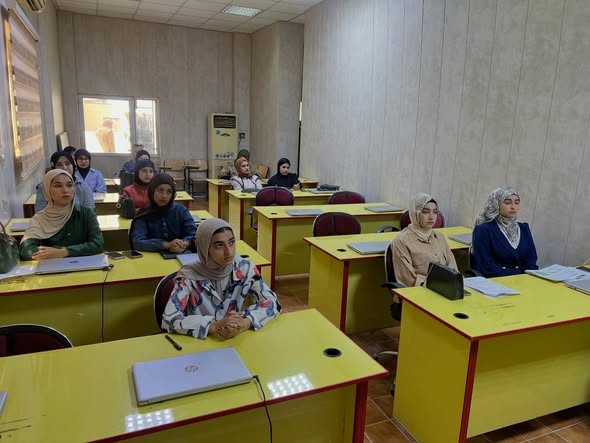
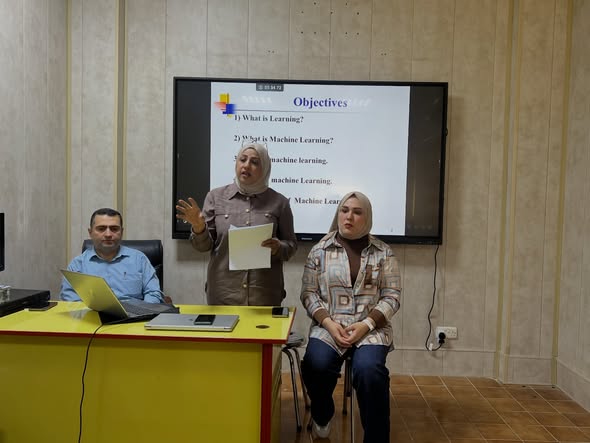
The Continuing Education Unit, in collaboration with the Department of Physics and under the patronage of Professor Dr. Sameera Naji Khdim, Dean of the College of Science for Women, organized a training course entitled “Machine Learning and Deep Learning.” The course was presented by Dr. Hiba Khudair Abbas, Dr. Nabil Janan Behnam, and Ms. Noor Hassan Rasham. It was held in the Abdul Hakim Hall and attended by a number of faculty members, administrative staff, and students.
The training course covered several key topics, beginning with the general concept of learning, defined as the process of acquiring knowledge or skills through study, experience, or practice. It also introduced the concept of Artificial Intelligence (AI), describing it as the capability of computer systems to simulate human intelligence in reasoning, decision-making, and problem-solving.
The course further explored the concept of Machine Learning (ML) as a major branch of artificial intelligence that focuses on developing systems capable of learning from data and improving their performance without explicit programming. These systems rely on computational algorithms to analyze data, identify patterns, and generate predictive models.
In addition, the course discussed Deep Learning (DL) as an advanced subset of machine learning that is based on multilayer artificial neural networks. Deep learning techniques are widely applied in image processing, speech recognition, and natural language processing due to their exceptional ability to learn from large-scale datasets and extract complex features with high accuracy.
The presenters also clarified the distinctions between Artificial Intelligence, Machine Learning, and Deep Learning. Artificial Intelligence was described as the broadest field encompassing all technologies that enable computers to emulate human intelligence. Machine Learning was presented as a specialized branch of AI that emphasizes data-driven learning, whereas Deep Learning was identified as a more advanced subset of Machine Learning that utilizes deep neural network architectures to solve highly complex computational problems.
The course concluded by emphasizing the growing importance of these technologies across scientific and practical disciplines, highlighting their significant contribution to advancing scientific research, fostering innovation, and keeping pace with rapid technological developments. The event featured active participation from attendees through questions and discussions, creating an engaging and productive learning environment.