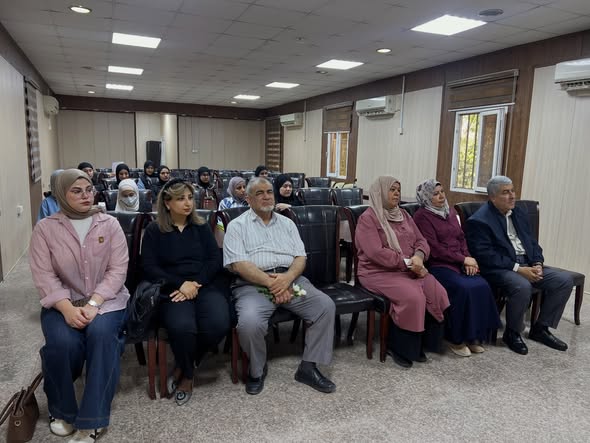
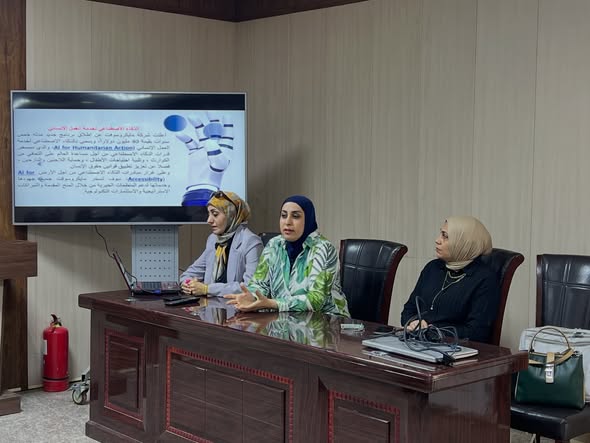
Under the patronage of the Dean of the College of Science for Women, Professor Dr. Sameera Naji Khdim, the Continuing Education Unit, in cooperation with the Department of Physics, organized a workshop entitled “Artificial Intelligence: A Double-Edged Sword.” The workshop was presented by Ms. Israa Razzaq Suwadi, Ms. Zainab Hazim Abdul Rahim, and Assistant Professor Rajaa Nader Keetan on Monday, 20 April 2026, and was held in the Hospitality Hall with the attendance of a number of faculty members, staff, and students.
The workshop aimed to clarify the significance of artificial intelligence (AI) in the contemporary era, while also addressing its positive and negative dimensions, as well as its legal, ethical implications and future prospects. It provided an overview of AI as a branch of computer science concerned with the development of systems capable of simulating human intelligence and performing tasks that typically require human cognition, such as learning from data, understanding language, recognizing images, making decisions, and predicting future outcomes.
The workshop highlighted the positive applications of AI, noting its extensive use in medicine for disease diagnosis and robotic surgery, as well as in hospital management. It is also widely applied in economics through market analysis and productivity enhancement via automation. In the education sector, AI supports scientific research, automated assessment, and other academic processes across various disciplines.
Regarding its negative aspects, the workshop emphasized that artificial intelligence can be exploited for misinformation and fake news generation, particularly when systems are trained on biased human data. It also raised concerns related to data security, including its potential use in cyberattacks and unauthorized system breaches.
In conclusion, the workshop stated that artificial intelligence is neither inherently a friend nor an enemy to humanity; rather, it reflects human decisions and values. When guided by knowledge and ethical principles, it can become one of the most powerful tools in human history. However, if used without regulation, it may pose significant global risks. The session also witnessed active engagement and discussion between participants and the lecturers, reflecting strong interest in the topic.