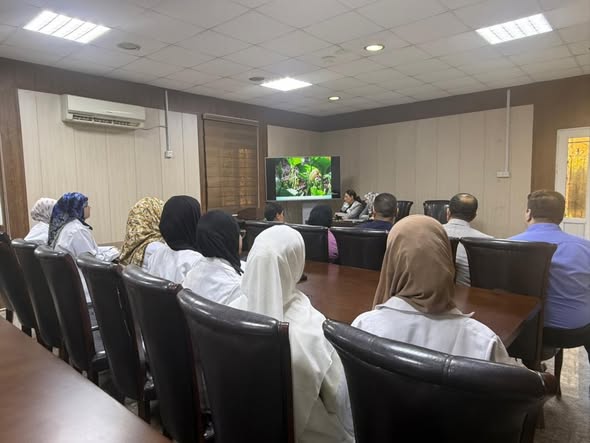
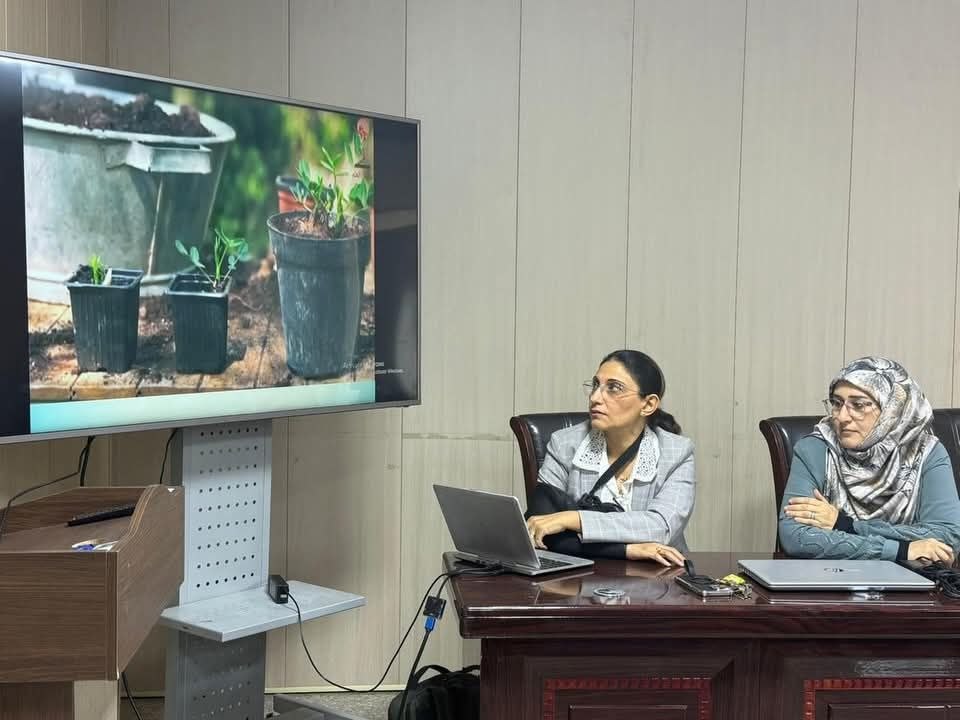
Under the patronage of the Dean of the College of Science for Women, Professor Dr. Sameera Naji Khdim, the Continuing Education Unit, in cooperation with the Department of Chemistry, organized a workshop entitled “Seed Hybridization and Its Impact on Human Health.” The workshop was presented by Assistant Professor Silvana Adour Yousif and Dr. Zainab Hussein Fadhil. It was held in the Hospitality Hall and attended by a number of faculty members, administrative staff, and students from the Department of Chemistry.
The workshop commenced with an overview of the importance of agriculture, which has served as the backbone of human civilization for thousands of years. As the world moves toward the future, the agricultural sector stands at a critical juncture, facing unprecedented challenges as well as promising opportunities. Given its capacity for continuous development and transformation, agriculture has become a focal point of numerous conferences and seminars organized by food security organizations. These initiatives aim to identify key priorities and effective strategies for addressing agricultural challenges and ensuring sustainable food production through the expansion and advancement of agricultural activities.
The presenters then outlined the primary objectives of the workshop, which included understanding the concept of seed hybridization, analyzing its benefits and potential risks, evaluating its effects on human health, and distinguishing it from genetic modification.
During the workshop, hybridization was defined as a planned breeding process that involves combining desirable genes from two different plant varieties to produce a new cultivar exhibiting selected characteristics inherited from both the male and female parent plants. Effective hybridization can generate a large number of genetic combinations, resulting in new genotypes that appear in subsequent generations.
The workshop further explained that the principal aim of plant hybridization is to enforce cross-pollination between pure lines. Since the flowers of most crop plants are hermaphroditic—containing both male and female reproductive organs within the same flower—self-pollination occurs naturally. Therefore, to achieve successful hybridization, self-pollination must first be prevented. The workshop also addressed various forms of plant propagation and hybridization, including seed hybridization, vegetative cuttings, and propagation through specialized structures such as bulbs.
The final section of the workshop focused on the impact of hybridization on human health. It was emphasized that hybridization, in itself, is not directly harmful to human health when conducted according to sound scientific principles. However, indirect effects may arise depending on agricultural practices, management methods, and patterns of use. Consequently, ongoing scientific research and regulatory oversight remain essential to ensure food safety and public health.
The workshop also featured an educational video illustrating the hybridization process. The session witnessed active engagement from the attendees, who interacted with the presenters through discussions and questions related to the topic.