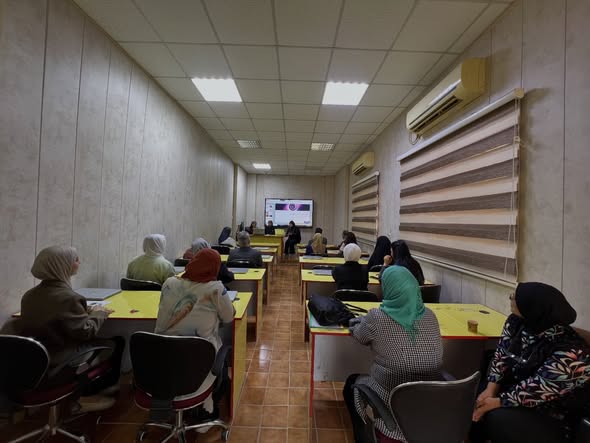
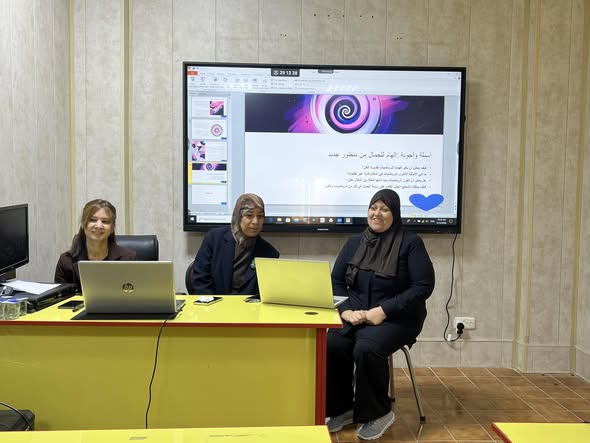
Under the patronage of the Dean of the College of Science for Women, Prof. Dr. Sameera Naji Khdim, the Continuing Education Unit, in cooperation with the Department of Mathematics, organized a workshop entitled “Mathematics and Art.” The workshop was presented by the Dean of the College, Dr. Muna Jasim Mohammed, and Dr. Asil Hassan Ali. It was held in Abdul Hakim Hall and attended by a number of faculty members, staff, and students.
The workshop aimed to highlight the close relationship between mathematics and art and aesthetics. Mathematics and art are often perceived as two contrasting fields—one based on logic and precision, and the other on emotion and free expression. This raises the question of whether an intersection exists between them, and whether mathematical equations can be as aesthetically pleasing as a painting, or whether artistic patterns can reflect profound mathematical concepts.
The lecturers explained the concept of the Golden Ratio as one of the secrets of beauty in nature and art. It is a mathematical constant approximately equal to 1.618, and it appears in numerous natural phenomena, from the arrangement of plant leaves to the spirals of shells. It has been regarded for thousands of years as a key to beauty and balance, influencing artists and architects across eras—from ancient civilizations to the Renaissance—where it was used to achieve harmony and proportion in artistic and architectural works.
The workshop also presented examples of the application of this ratio in abstract art and its connection to mathematical principles. Despite its apparent distance from mathematics, abstract art is often grounded in mathematical concepts, as some artists employ algorithms and fractions to introduce complexity into their works, resulting in forms and patterns that invite exploration of the hidden structures underlying them.
Furthermore, the workshop addressed mandala art and mathematical symmetry, defining mandalas as intricate circular designs based on the repetition of patterns around a central point, reflecting balance and harmony. The relationship between mathematics and music was also discussed through numerical harmony, such as the Pythagorean musical scale, rhythm, time signatures, chords, and the Fibonacci sequence.
The workshop witnessed clear engagement from the attendees and was well received due to its scientific and cultural content, which contributes to raising awareness of the importance of mathematics and its role in life in general, and in culture and art in particular.