A workshop entitled “The Importance of Mathematics in Generative Artificial Intelligence (Creative AI)” was organized under the patronage of the Dean of the College of Science for Women, Professor Dr. Sameera Naji Khdim. The Continuing Education Unit, in collaboration with the Department of Mathematics, held this workshop.
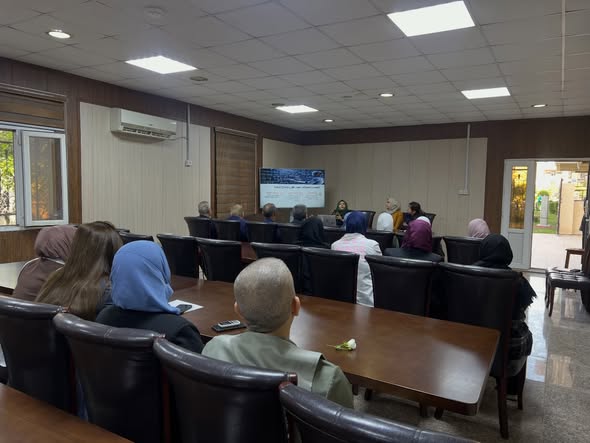
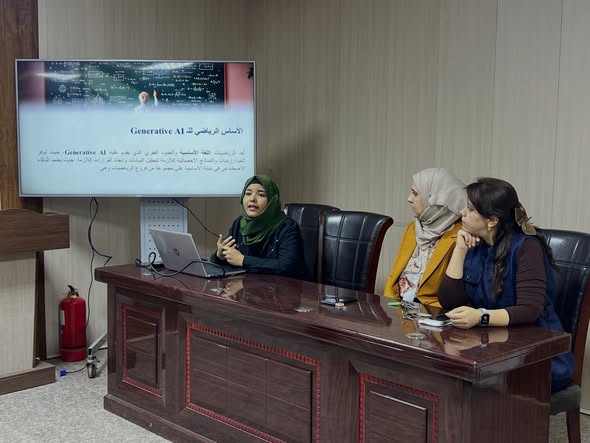
The workshop was presented by Ms. Samaa Mohammed Izzat, Ms. Huda Imad Al-Din Jameel, and Ms. Fatima Ahmed Shihab. It took place in the Hospitality Hall and was attended by a number of faculty members, staff, and female students from the department.
The workshop aimed to introduce generative artificial intelligence as a branch of artificial intelligence that focuses on creating new content rather than merely analyzing existing data. The lectures highlighted the importance of statistics and probability in mathematics and their fundamental role in the functioning of artificial intelligence systems. These fields constitute the theoretical foundation that enables systems to process data, extract patterns, and make decisions. They also play a crucial role in the development of modern algorithms and in achieving a precise understanding of their behavior.
Developers of artificial intelligence systems rely on these mathematical tools to build models capable of learning from data and adapting to new inputs. As artificial intelligence technologies continue to advance, the need for a deeper understanding of the complex mathematical concepts that underpin them becomes increasingly essential. Consequently, statistics and probability can be regarded as the backbone of generative models.
The workshop further emphasized the strong interconnection between the future of mathematics and generative artificial intelligence. Progress in one field opens new horizons in the other, potentially leading to the emergence of new mathematical disciplines dedicated to understanding and advancing artificial intelligence systems. At the same time, advanced AI technologies are expected to contribute to solving complex mathematical problems.
The workshop witnessed notable engagement between the attendees and the organizers, reflected in active discussions and exchanges.