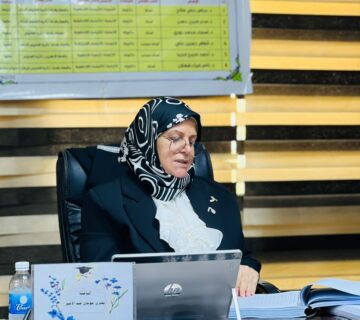
Master’s Discussion
The College of Science for Women at the University of Baghdad discussed the Master’s thesis entitled “Numerical Modeling of Vertical-Cavity Surface-Emitting Laser for Photonics Design”
by researcher Rand Mahdi.
The study dealt with the design and modeling of a Vertical-Cavity Surface-Emitting Laser (VCSEL) operating at a target wavelength of 850.0 µm, where the Transfer Matrix Method (TMM) was used in a one-dimensional model to design and analyze the Distributed Bragg Reflectors (DBR). Then, the Finite Element Method (FEM) was used to develop a two-dimensional model that enables the study of the optical, electrical, and thermal characteristics of the device using RSoft LaserMOD software.
The device structure was based on Distributed Bragg Reflectors made of Al₀.₅₅Ga₀.₄₅As, with 36 pairs for the bottom mirror and 32 pairs for the top mirror, with an active region consisting of three quantum wells, each with a thickness of 0.008 µm, and an oxide aperture with a diameter of 10 μm, with the aim of comparing the performance of the one- and two-dimensional models.
The results showed that the emission peaks in the two-dimensional model reached approximately 857 nm for GaAs and 860 nm for AlGaAs. The threshold current at a temperature of 300 K was approximately 0.45 mA for GaAs and 0.67 mA for AlGaAs. The results also showed an optical gain of 350 cm⁻¹ for the AlGaAs structure, compared with 400 cm⁻¹ for the GaAs structure. The mode field diameter was 3.4 μm and the divergence angle was 18° for the AlGaAs structure, compared with 4 μm and 24° for the GaAs structure, with self-heating effects appearing at elevated temperatures.
-
- Study the influence of different aluminum concentrations in AlGaAs on the optical and thermal characteristics of VCSEL devices.
- Optimize the cavity geometry and oxide aperture dimensions to improve mode confinement and minimize optical losses.
- Extend the analysis to a three-dimensional (3D) model for more accurate representation of the behavior of real devices.
- Experimentally validate the numerical results to ensure the accuracy and reliability of the simulation models.
The researcher was awarded a (Distinction).