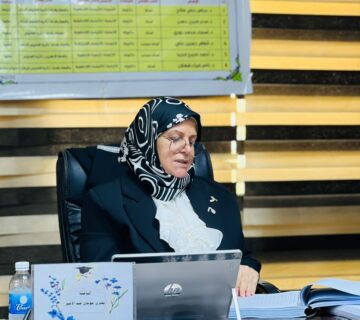
Master’s Discussion
The College of Science for Girls at the University of Baghdad discussed the master’s thesis titled “Temporal and Spatial Variation in the Physical and Chemical Characteristics of Water and the Composition of Benthic Invertebrate Communities at Selected Sites on the Tigris River Through the City of Baghdad – Iraq” by the student Mouj saad monam. The thesis was presented to fulfill the requirements for obtaining a Master’s degree in Life Sciences / Ecology, under the supervision of Assoc. Prof. Dr. Nadia Emad Tareq Al-Amin and Experienced Dr. Abdul Hamid Muhammad Jawad Al-Obaidi.
The study aimed to assess the quality of the Tigris River water by measuring a range of physical and chemical properties, including water temperature, pH, electrical conductivity (EC), total dissolved solids (TDS), turbidity, dissolved oxygen (DO), and biological oxygen demand (BOD₅), as well as concentrations of nitrates, phosphates, sulfates, and some heavy metals. It also aimed to study the composition of the benthic invertebrate community and determine how their density and diversity varied across the studied sites, using biological indicators to evaluate the environmental status of the Tigris River.
The results showed temporal and spatial variation in the physical and chemical properties of the Tigris River water. Air temperature ranged between 18–51°C, and water temperature ranged between 7–33°C, while pH values ranged from 6.7–8.9, total dissolved solids between 342–1500 mg/L, electrical conductivity between 697–1250 µS/cm, and turbidity between 4.5–85 NTU. Nitrate concentrations ranged from 2.5–19.6 mg/L, phosphate from 0.05–2.2 mg/L, biological oxygen demand (BOD) from 1.2–6.5 mg/L, and dissolved oxygen from 2.24–8.93 mg/L.
A total of 5,902 benthic invertebrates were recorded, spread across 12 taxonomic groups, with the Chironomidae family and the genus Gammarus spp. being the most abundant groups. Results from the biological indicators BMWP, ASPT, HBI, and Shannon showed differences between the studied sites. Site S1 (Al-Muthanna Bridge) showed relatively better environmental conditions, while Site S4 (Thermal Power Plant) indicated higher environmental stress and pollution compared to the other sites.
The study recommended continuing regular monitoring programs for the water quality of the Tigris River and adopting an integrated approach using physical, chemical, and biological indicators to assess the river’s environmental status. It also recommended reducing sources of waste and pollutant discharge into the water, paying more attention to monitoring nutrient concentrations and heavy metals, and incorporating benthic invertebrate communities and their biological indicators into environmental assessment programs, due to their ability to respond to changes in water quality and provide comprehensive information about the river system’s environmental condition.
Final Grade for the Master’s Thesis : Excellent