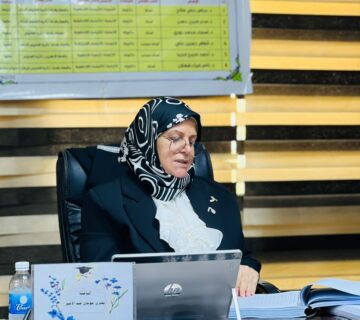
Master’s Discussion
The College of Science for Women at the University of Baghdad held the defense of the master’s thesis entitled “Sustainable Weed Management and Yield Enhancement in Mung bean through Biofertilizer and Allelopathic Sorghum Mulch”, submitted by Hanan Dhahir Ayyash in partial fulfillment of the requirements for the degree of Master in Biology/Botany, under the supervision of Assist. Prof. Dr. Arwa Abdul-Kareem Tawfiq and First Senior Chief Researcher Dr. Tamara Adnan Ali.
The thesis aimed to evaluate the use of sorghum residues as an organic material and allelopathic mulch on the soil surface, applied either alone or in combination with half the recommended herbicide rate, and to investigate the interaction of these treatments with chemical fertilization and Rhizobium biofertilization in weed management and improving the growth and productivity of mung bean, with the aim of reducing reliance on chemical inputs and promoting sustainable agricultural practices.
The thesis yielded important results, most notably that the application of sorghum residues at a rate of 6 t ha⁻¹ as allelopathic mulch on the soil surface, combined with Rhizobium biofertilization and half the recommended rates of Bentazon herbicide and chemical fertilizers, contributed to reducing weed growth and competition with mung bean, which positively affected plant growth and productivity. These findings indicate the potential for reducing reliance on chemical inputs, including fertilizers and herbicides, while maintaining good crop productivity, thereby supporting the application of integrated weed management principles and promoting sustainable agriculture.
The study recommended using sorghum residues, which contain allelopathic compounds that help suppress weeds, as soil mulch in combination with half the recommended rate of Bentazon herbicide. It also recommended integrating Rhizobium biofertilization with half the recommended rate of chemical fertilizers, with the aim of improving the growth and productivity of mung bean and controlling associated weeds, thereby contributing to reducing reliance on chemical inputs and promoting sustainable weed management.