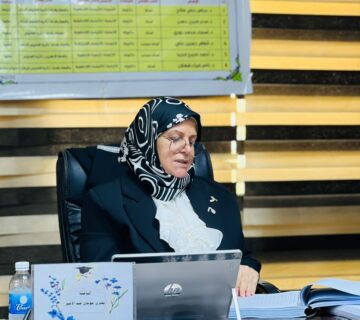
Master’s Discussion
The College of Science for Women, University of Baghdad discussed the Master’s thesis entitled “The Combined Impacts of Warming and Nutrients Inputs on Phytoplankton and Zooplankton in a Freshwater Ecosystem”, presented by the postgraduate student (Yaqeen Ameen Kadhim), in partial fulfillment of the requirements for the degree of Master in Biology/ Ecology, under the supervision of Prof. Dr. Jinan Shawi Al-Hassany.
- The thesis aimed to investigate the combined and individual impacts of warming and nutrients inputs on phytoplankton and zooplankton structure and abundance in a freshwater ecosystem, and it offers valuable insight into their short-term responses to warming and nutrients inputs during climate-change microcosm experiments.
The thesis concluded that both the combined and individual impacts of warming and nutrients inputs resulted in changes in chlorophyll-a concentration and in the structure and relative abundance of phytoplankton and zooplankton communities, by favouring tolerant Cyanophyceae species, while Bacillariophyceae remain the dominant group under a wide range of environmental conditions, Copepods were the dominant zooplankton, likely benefiting more from the combined effects of high temperature and nutrient enrichment at the expense of their prey, as rotifers were more abundant during the middle of the experiment. Zooplankton density was inversely related to phytoplankton density, likely due to grazing. The system exhibited a temporal shift from a bottom-up control dynamic in the early stages to a top-down control dynamic in the later stages.
- The thesis recommended to examine the combined nutrient treatment (NO₃⁻+PO₄³⁻) and full interaction treatment (Temperature+NO₃⁻+PO₄³⁻) to further improve understanding of phytoplankton and zooplankton responses, particularly nutrient co-limitation (N vs. P vs. N+P), nutrient stoichiometric effects (N:P ratio), and whether warming amplifies balanced nutrient enrichment. Longer-term, larger-scale experimental studies are recommended at various locations along the Tigris River and in other freshwater systems in Iraq, with the aim of gaining a broader understanding of ecosystems responses. Additional research on bacterial communities is needed, given their important role in regulating phytoplankton and zooplankton dynamics through nutrient cycling and organic matter decomposition. Continuous monitoring programs and environmental management strategies should be implemented to track changes in temperature and nutrient concentrations and to mitigate the effects of eutrophication on plankton community structure and ecosystem functions.
The researcher was awarded the grade of Excellent.