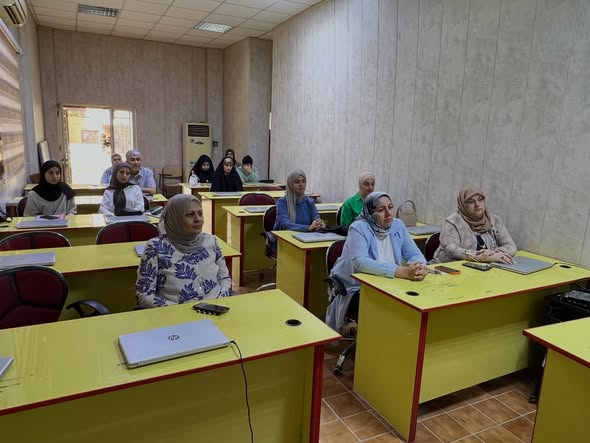
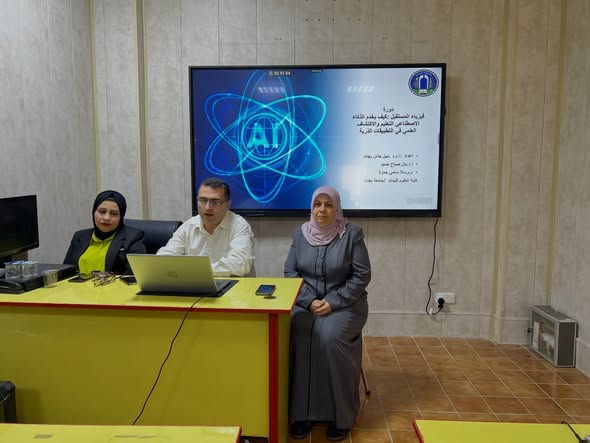
The Continuing Education Unit, in collaboration with the Department of Physics and under the patronage of Professor Dr. Sameera Naji Khdim, Dean of the College of Science for Women, organized a training course entitled “Physics of the Future: How Artificial Intelligence Supports Education and Scientific Discovery in Atomic Applications.” The course was presented by Dr. Nabil Janan Behnam, Dr. Ban Sabah Hamid, and Ms. Sula Sami Hamza in the Abdul Hakim Hall, with the attendance of a number of faculty members, administrative staff, and students.
The course aimed to highlight the significance of artificial intelligence (AI) as a branch of computer science concerned with the design and development of intelligent systems capable of performing tasks that traditionally require human intelligence. These tasks include learning from data, pattern recognition, natural language understanding, decision-making, prediction, and problem-solving. The presenters emphasized that AI should be regarded as a supportive tool that enhances educational and research processes rather than a substitute for human reasoning. They also stressed the importance of verifying the accuracy and reliability of AI-generated information and its sources.
Furthermore, the course addressed the concept of AI-supported education, which involves the integration of AI technologies into teaching and learning processes through personalized educational content, analysis of students’ performance, provision of timely feedback, and assistance to instructors in preparing educational materials and academic reports.
The training also included demonstrations of selected AI applications, particularly ChatGPT, with an explanation of its interface and guidelines for its effective and responsible use. In addition, the presenters discussed the application of AI in physics, emphasizing its role in complex data analysis, scientific modeling, and atomic applications. These capabilities contribute to advancing scientific research, improving analytical accuracy, and opening new horizons for researchers. The course concluded with active engagement and discussions between the participants and the presenters, reflecting the growing interest in the integration of artificial intelligence into higher education and scientific research.