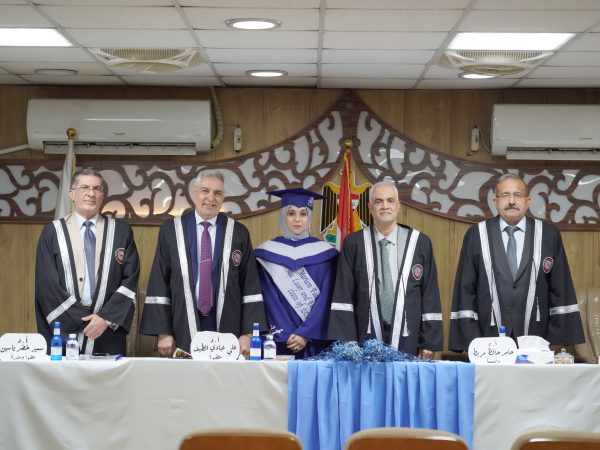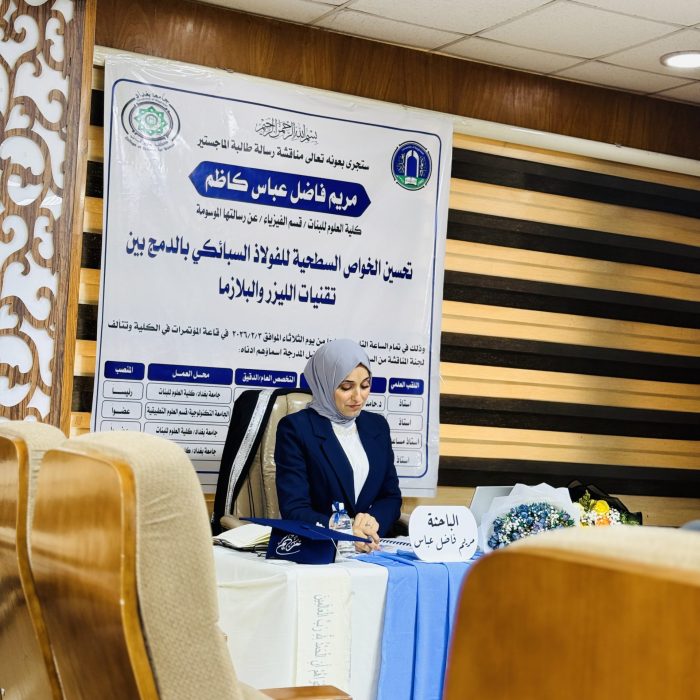
Master’s Discussion
College of science for women/University of Baghdad examined the thesis entitled (Improving the surface properties of alloy steel using of Laser and Plasma techniques) of the student Mariam Fadhil Abbas Khadhim
The aim of our objected is to study the effect of laser and plasma techniques on the surface properties of alloyed steels, includes hardness, wear resistance, and corrosion resistance, for applications requiring durable and high-performance steel surfaces in industries like automotive and tool manufacturing.
The thesis/dissertation also includes The thesis also This study investigates the effect of combining laser and microplasma treatment on a medium-carbon steel surface, where laser treatment was applied first, followed by microplasma treatment.
It also examines the effect of combining laser and dielectric barrier discharge plasma on a carbon steel surface, using the same sequence: laser treatment first, followed by a dielectric barrier discharge plasma. Laser treatment was performed using a pulsed Nd:YAG laser with an energy of 2000 mJ at a wavelength of 1064 nm. The pulse duration was 10 ns, and the beam diameter was 4 mm. The micro plasma treatment used a voltage of 16 kV, an exposure time of 12 minutes, and an argon gas flow rate of 2 L/min. The same laser type and parameters were used for the steel surface, followed by treatment with a dielectric barrier discharge (DBD) plasma at an applied voltage of 15 kV and an exposure time of 12 minutes.
Laser treatments lead to a notable increase in surface hardness, wear resistance, the combined treatment of laser and plasma achieved the greatest improvement. Specifically, microhardness tests showed 320 Hv for the laser-treated sample, 353 Hv for the microplasma -treated sample, and approximately 479 Hv for the sequential microplasma–laser process. This improvement results from localized phase transformation, plasma-induced surface activation and rapid thermal cycling, which collectively enhanced the surface microstructure. Moreover, wear test analysis confirmed a significant reduction in material loss with the combined treatment compared to single processes, validating the synergistic effect of microplasma and laser modification.
The results of corrosion confirm that the untreated surface exhibits the highest corrosion activity, as shown by the high corrosion current value (2.4477×10⁻³ A/cm²). Laser surface treatment significantly improved corrosion behavior. However, combining the laser with plasma produced greater enhancements. Dielectric barrier discharge plasma reduced the corrosion current to (8.849×10⁻⁶ A/cm²). The microplasma achieved the best performance by recording the lowest value (2.628×10⁻⁶ A/cm²). Accordingly, plasma techniques—especially the microplasma—provide the highest level of protection. These techniques form more stable, dense surface layers and substantially increase corrosion resistance compared to the untreated or laser-only treated surface. Overall, these results demonstrate that, consequently, combining both techniques is a promising and reproducible approach to improve surface hardness and wear resistance of carbon steels for demanding industrial applications.
The most important recommendations which the study has come up with and the average obtained:
- This work can be expanded to study the effect of laser and plasma on the surfaces and alloys of other metals.
- The effect combining laser and plasma on other mechanical properties, such as fatigue, can be studied for different types of alloys.
- The effect of CO2 lasers can be studied and then combined with plasma.
- Apply the findings of this study in the design and manufacturing of cutting tools to improve their performance and durability.
- Conduct the study using condition of vacuum to reduce contamination.
- Investigate other corrosion factors, such as temperature and molar concentration of corrosive solutions, as well as wear parameters like sliding speed and varying applied load, to expand understanding of material behavior.
the average obtained: Very Good (Hight)