Master’s Discussion
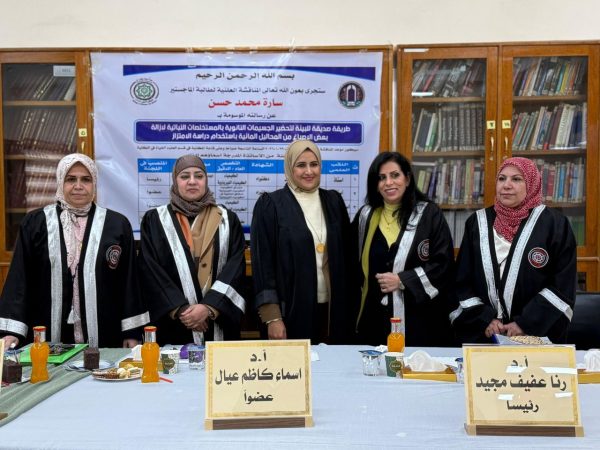
The College of Science for women at the University of Baghdad discussed the master’s thesis entitled (Study of Methylene Blue Dye Removal from Aqueous solution by Adsorption using a Plant Extract (Eco- friendly) with the preparation of Supporting Nanometal Oxides)
By the student: Sara Mohammed Hassan
1- Prepare a plant-based adsorbent surface using chemical treatment of Euphrates poplar (EP), in addition to preparing nano-oxides of transition elements (CuO, Mn₂O₃, and Mn₂CuO₄), focusing on analyzing the physical and chemical properties of the prepared surfaces using the following techniques: XRD, EDX, BET, FESEM, TEM, and FTIR.
2- Study the adsorption behavior of these surfaces at different temperatures for methylene blue dye.
3- Study the adsorption kinetics and thermodynamic factors of the adsorption of some dyes on the plant-based adsorbent surface and the nanomaterials prepared from their solutions.
4- Study adsorption theories to analyze the behavior of materials during the adsorption process, using mathematical models such as the Linkmeier, McKinney, and Freundlich equations.
5- These studies aim to accurately interpret experimental data and select the most suitable model for a precise description of the adsorption process under investigation.
The study was conducted at the University of Baghdad / College of Science for Girls / Department of Chemistry in Baghdad / Iraq from August 2024 to March 2025. Nanoxides (Mn2O3, CuO and Mn2CuO4) were prepared, in addition to the preparation of a nano-surface from the Euphrates poplar plant, its characterization, and the analysis of its physical and chemical properties using techniques (XRD, EDX, FTIR, FESEM, TEM, BET), then the application of an adsorption study to remove methylene blue dye from its aqueous solutions.
The most important recommendations which the study has come up with and the average obtained:
- Use environmentally friendly and low-cost adsorbent surfactants to purify water from pollutants, such as industrial and agricultural waste.
- Use Euphrates poplar powder and the prepared oxides to treat and remove other polluting dyes that contribute to environmental degradation.
- Prepare nanoparticles of various elements using diverse plant leaves, focusing on studying the factors affecting the synthesis process, such as temperature and the amount of mass used.
- Analyze the effect of particle size on adsorption capacity and understand its impact on process efficiency.
- Study the surface charge of the adsorbent and analyze its effect on adsorption capacity.