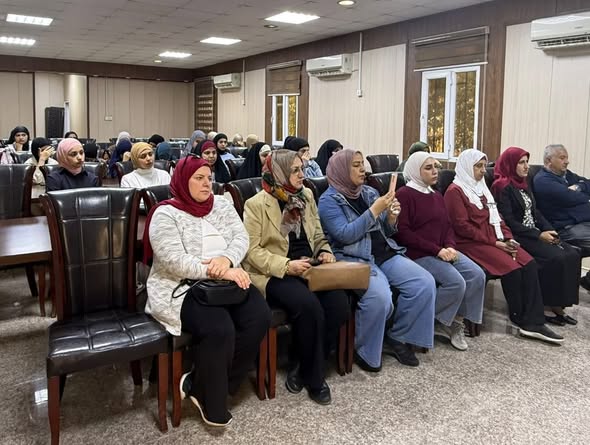
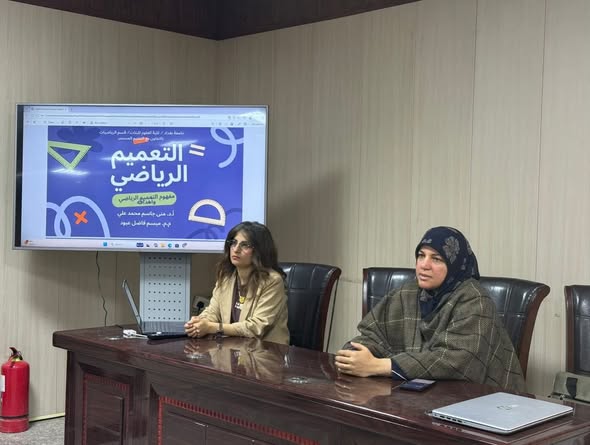
Under the patronage of the Dean of the College of Science for Women, Professor Dr. Sameera Naji Khdim , the Continuing Education Unit, in cooperation with the Department of Mathematics, organized a scientific workshop entitled “The Concept of Mathematical Generalization and Its Objectives.”The workshop was presented by Ms. Maysam Fadhil Aboud and Ms. Nidhal Mohsen Abdul Ameer, in the presence of a number of faculty members, students, and individuals interested in the mathematical sciences.
The workshop aimed to highlight the concept of generalization in mathematics as one of the fundamental pillars in the construction of mathematical theories and the development of abstract thinking. Generalization is regarded as the process of moving from specific cases to the formulation of general rules and statements that broaden the scope of understanding and inference. The presenters discussed the theoretical foundations of mathematical generalization, its various types, and the mechanisms through which partial examples are transformed into comprehensive laws, while also explaining its role in developing students’ logical reasoning and mathematical analysis skills.
The workshop also included practical applications demonstrating how generalization can be employed in solving mathematical problems, constructing proofs, and discovering relationships among different mathematical concepts. Furthermore, it addressed the significance of generalization in scientific research and in the development of educational curricula in ways that promote creative and critical thinking.
It was emphasized that generalization is not merely a mathematical tool; rather, it represents a scientific methodology that contributes to the systematic organization and coherent construction of knowledge. The workshop concluded by underscoring the importance of developing students’ and researchers’ skills in mathematical thinking and systematic generalization, as well as their role in supporting scientific research and improving the quality of academic studies in mathematics and related disciplines.