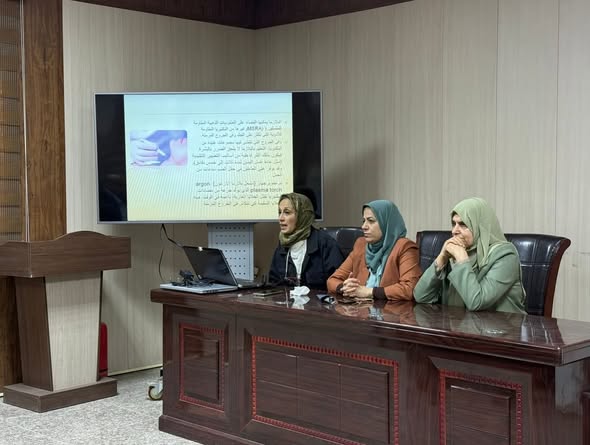
Under the patronage of the esteemed Dean of the College of Science for Women, Professor Dr. Sameera Naji Khdim , the Continuing Education Unit, in collaboration with the Department of Physics, organized a scientific workshop entitled “Plasma and Its Impact on Food Contaminants.” The workshop was presented by Dr. Alia Hussein Ali, Dr. Dowsar Hussein Ghaib, and Dr. Hanaa Mohammed Yaseen, in the presence of the Department Chair, Dr. Haider Yahya Hamoud, as well as a number of faculty members and department staff.
The workshop addressed the critical importance of food safety, highlighting it as a vital issue that directly affects public health and the global economy. Food contaminants annually cause millions of cases of foodborne illness, necessitating the search for effective and safe sterilization techniques that overcome the limitations of conventional methods. The presenters emphasized the use of non-thermal plasma technology (Cold Atmospheric Plasma – CAP) as a modern approach for food sterilization without causing thermal damage to food components. The workshop explained the mechanism by which plasma eliminates various types of bacteria, including antibiotic-resistant strains, through the generation of reactive oxygen and nitrogen species that disrupt microbial cell walls without adversely affecting healthy tissues or the intrinsic properties of food.
Furthermore, the workshop highlighted medical applications of plasma, such as the development of devices like the argon plasma torch, which contributes to the sterilization of chronic wounds and supports the proliferation of healthy cells. The topic of food irradiation was also discussed, indicating that numerous products—such as onions, potatoes, fruits, vegetables, spices, fish, and poultry—can undergo this process to reduce microbial load and extend shelf life without compromising food safety. The presenters affirmed that ionizing radiation effectively eliminates microorganisms and that the absorbed energy does not induce nuclear reactions in food.
The workshop concluded by emphasizing the importance of developing the skills of students and researchers in modern technologies for addressing food contaminants, highlighting their role in supporting scientific research, enhancing the quality of studies, and promoting food safety standards within the community.