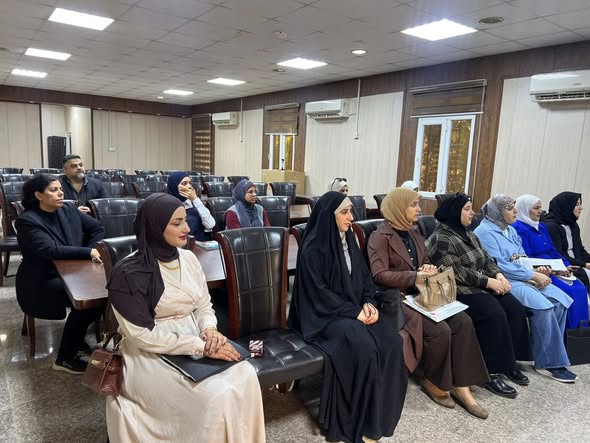
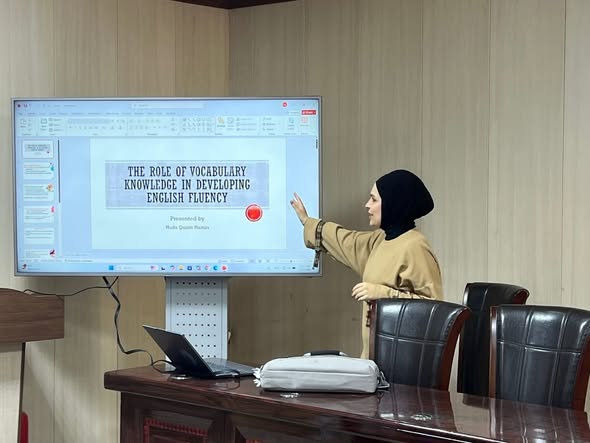
Under the patronage of the respected Dean of the College of Science for Women, Professor Dr. Sameera Naji Khdim , the Continuing Education Unit, in cooperation with the Computer Science Department and the Blended Learning Unit at the College of Science for Women, organized a scientific workshop entitled “The Role of Vocabulary Knowledge in Developing English Fluency.”The workshop was presented by Ms. Huda Qasim Hamza as part of a series of scientific activities aimed at developing students’ linguistic and academic skills.
The workshop addressed the pivotal role of vocabulary in fostering fluency in the English language. The presenter emphasized that possessing a diverse and precise lexical repertoire constitutes one of the most fundamental foundations enabling learners to express themselves accurately and clearly, while enhancing their abilities in reading comprehension, listening comprehension, and effective participation in academic discussions. The workshop also reviewed key modern strategies for vocabulary acquisition, including contextual learning, the use of mind maps, spaced repetition techniques, and the employment of digital applications to reinforce newly learned words and connect them to practical usage.
Furthermore, the workshop explored the relationship between in-depth vocabulary knowledge—regarding meaning, usage, and structure—and the level of linguistic fluency. It stressed that vocabulary development is not limited to memorization but rather involves active use in authentic communicative contexts, which contributes to increased self-confidence and improved academic and professional performance among students. The workshop included practical applications and interactive activities designed to assess participants’ vocabulary levels and train them in systematic methods for expanding their lexical repertoire.
The workshop concluded by underscoring the importance of developing the skills of students and researchers in the field of English language studies, particularly vocabulary development as the cornerstone of achieving linguistic fluency, and its vital role in supporting scientific research and enhancing the quality of academic studies.