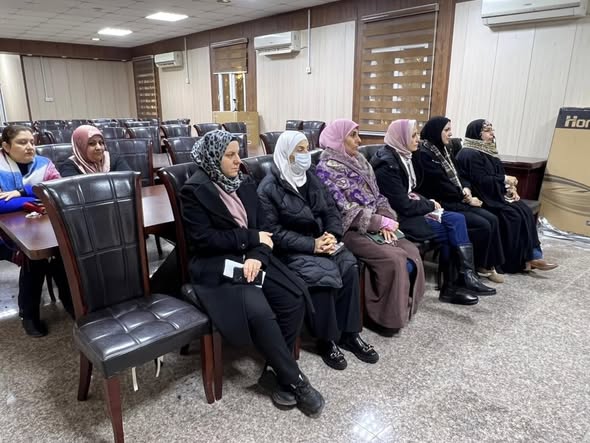
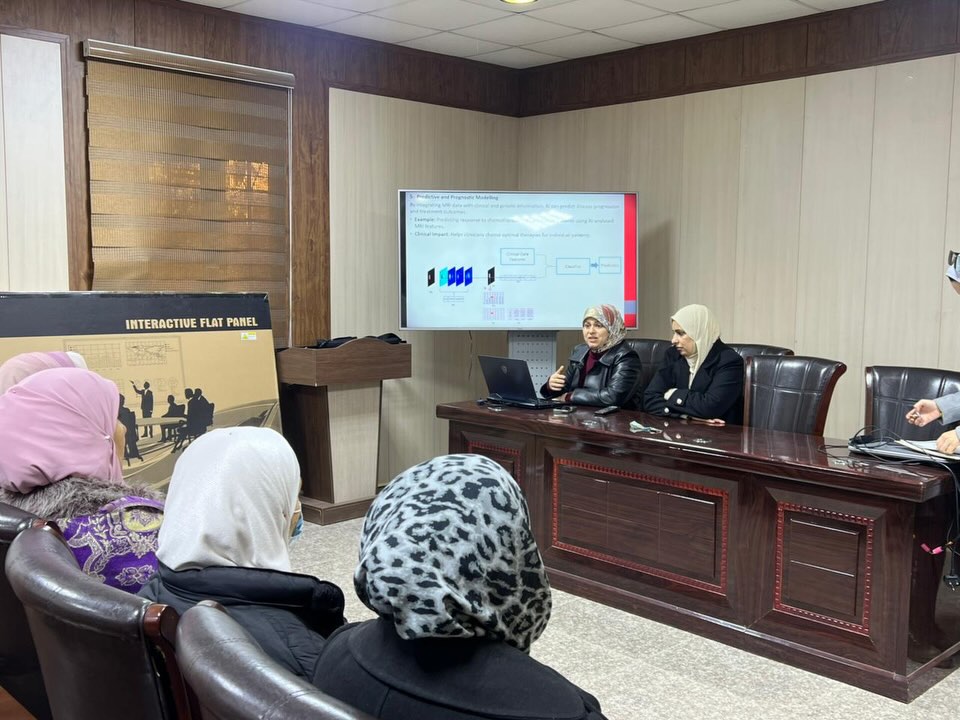
Under the patronage of the esteemed Dean of the College of Science for Women, Professor Dr. Sameera Naji Kazem, the Continuing Education Unit, in cooperation with the Department of Physics Sciences, organized a workshop entitled “Artificial Intelligence and Magnetic Resonance Imaging: The Future of Diagnosis and Research.” The workshop was presented by Dr. Salma Ali Redha and Dr. Noha Hassan Harb.
The workshop aimed to introduce the concepts of artificial intelligence and machine learning, and to highlight their growing role in improving magnetic resonance imaging (MRI) techniques, particularly in the fields of early medical diagnosis, high-precision medical image analysis, accelerating examination time, and reducing human error in interpreting results.
The workshop included a scientific explanation of the mechanisms for integrating artificial intelligence algorithms with MRI technologies, and their role in enhancing image quality, detecting complex pathological patterns, and supporting medical decision-making. In addition, the latest global research and studies were reviewed to illustrate the future of these technologies in diagnosis and treatment.
The workshop also discussed the importance of employing artificial intelligence in scientific research, its role in analyzing big data, developing predictive models, and strengthening collaboration between physics and medical sciences. This contributes to opening new research horizons for postgraduate students and researchers.
The workshop witnessed fruitful scientific interaction from the attendees through discussions and interventions focusing on the ethical and technical challenges associated with the use of artificial intelligence in the medical field, as well as ways to develop scientific skills to keep pace with these rapid transformations.
At the conclusion of the workshop, emphasis was placed on the necessity of continuing to organize specialized scientific workshops that enhance both knowledge and practical application, and link higher education outcomes with modern scientific developments, in a manner that serves both society and the academic institution.