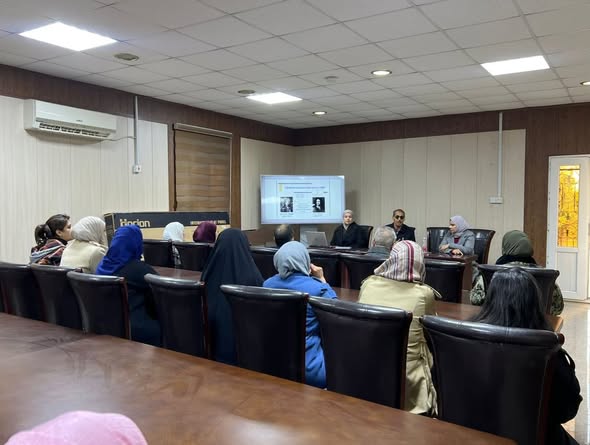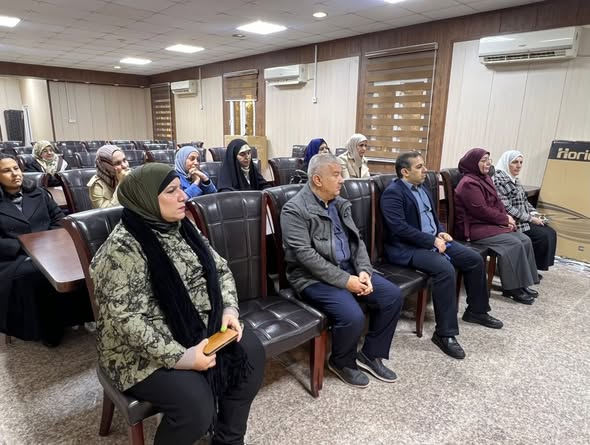

Under the patronage of the esteemed Dean of the College of Science for Women, Professor Dr. Sameera Naji Khdim, the Department of Mathematics, in cooperation with the Continuing Education Unit, organized a scientific workshop entitled “Fractional Calculus.” The workshop was held in the Hospitality Hall and attended by a number of faculty members and staff.
The workshop was presented by Professor Dr. Saad Naji Ali, Assistant Lecturer Samah Mohammed Ali, and Assistant Lecturer Israa Abbas Ibrahim.
The workshop aimed to introduce the concept of fractional calculus, clarify its scientific importance, and review its modern applications in various branches of science and engineering.
Fractional calculus is a generalization of the traditional concepts of differentiation and integration to non-integer (fractional) orders, meaning that the order of a derivative or integral is not limited to integers but can also be fractional or real numbers. This field is considered relatively modern within mathematical analysis, due to its high capability in modeling complex phenomena that cannot be accurately described using classical calculus.
The presenters explained that fractional calculus is distinguished by its ability to describe systems that depend on memory and historical behavior, a feature not provided by classical calculus. It also contributes to developing more accurate mathematical models for many natural and physical phenomena.
The workshop addressed a range of important applications of fractional calculus, most notably in physics for modeling complex phenomena such as anomalous diffusion and memory-dependent systems; in engineering for analyzing control systems and signal processing; and in medicine and biological sciences, where it helps describe drug diffusion dynamics within the body and model certain biological processes.
At the conclusion of the workshop, the presenters emphasized the importance of giving greater attention to this field and incorporating it into the interests of researchers and postgraduate students, due to its significant role in modern scientific research and practical applications.