Master’s Discussion
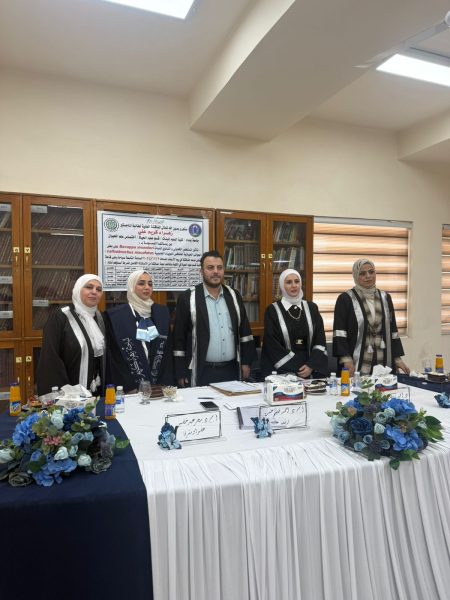
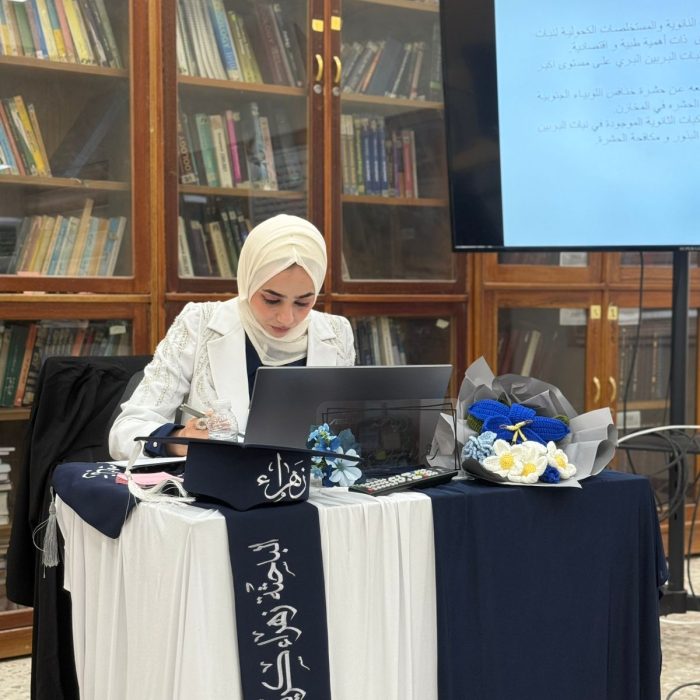
The College of Science for Women / University of Baghdad examined the thesis entitled (Isolation and Identification of some saponins and trepenoids and their chitosan-nano composites of Bacopa monnieri plant and evaluation of some Biological Aspect of callsobruchus maculatus) The thesis submitted by student Zahraa Kareem Ali to obtain a Master’s degree in Biology/ Zoology, under the supervision of Assistant Professor Dr. sahar Abd Khudair
The study focused on isolating and characterizing the active compounds from wild purslane (Berberis monnieri) and their effect on the southern cowpea beetle. Nanoparticles were also used. The results showed that wild purslane (B. monnieri) contains several secondary compounds, including terpenes and saponins, which are believed to have biological activity against the insect. Terpene compounds were identified using GC-MS, isolating 22 chemical compounds. The most abundant compounds were neophytadiene, hexadecanoic acid, and octadec-9-enoic acid. The functional groups of the saponin and terpene nanostructures were revealed using FTIR spectroscopy. The nanooparticles prepared from the wild purslane extract possess characteristics that give them high efficiency in terms of small size, stability, and effectiveness.
The message included a study of the effect of terpene and saponin compounds isolated from the wild purslane plant on the southern cowpea beetle and how to control it. The nanocapsules of terpene and saponin compounds were characterized through various modern techniques, including Fourier transform spectroscopy, scanning electron microscopy (SEM), dynamic light scattering (DLS), and zeta potential determination. The results showed the feasibility of preparing nanocapsules using the dispersion method for extracts of terpenes and saponins. The granular size (DLS) of the nanocapsules of the plant extracts of terpenes and saponins reached 219.9 nm for saponins and 339.7 nm for terpenes. Scanning electron microscopy (SEM) images showed that the nanocapsules of the terpene and saponin extracts had irregular shapes and varying sizes, with average sizes ranging from 25.56 to 29.96 nm for saponins and 24.11 to 18.38 nm for terpenes, respectively
The study recommended conducting an investigation into the extraction of secondary compounds found in wild purslane and testing their effectiveness in seed protection and insect control. It also recommended applying the results of the nanocapsule and extract results from wild purslane to other insects of medical and economic importance.
the average obtained Excellent