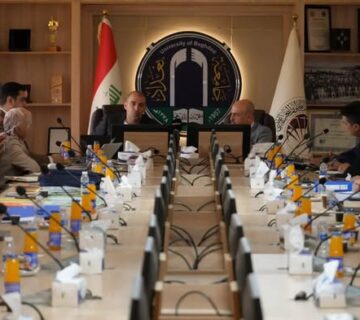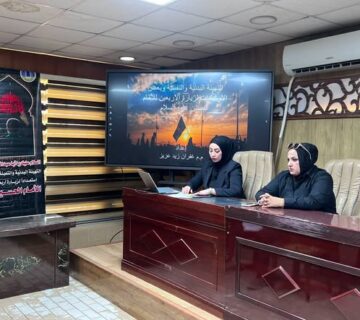

Under the patronage of Prof. Dr. Sameera Naji Khdim, Dean of the College of Science for Women, the Continuing Education Unit, in cooperation with the Department of Physics, organized a workshop entitled “Laser Technology and Food.” The workshop was presented by Dr. Hana Mohammed Yaseen, Assist. Prof. Mona Mahdi Saleh, and Ms. Shahad Abdul-Jabbar Aziz. It was held in Abdul Hakim Hall and attended by a number of faculty members, staff, and female students.
The workshop introduced the concept of laser technology and its physical properties. Laser light is characterized by its monochromaticity, coherence, high degree of concentration, and highly directional propagation. These distinctive properties have made lasers one of the most important modern technologies used in a wide range of scientific and practical applications.
The workshop also reviewed the major applications of lasers in medicine, surgery, telecommunications, and optical fiber technologies, as well as their applications in the industrial sector, measurement and instrumentation, education, and scientific research, owing to their high precision and operational efficiency. An important component of the workshop focused on the use of helium–neon (He–Ne) lasers in plant irradiation. Particular attention was given to an experiment involving the irradiation of eggplant seeds, in which laser treatment contributed to accelerating seed germination and positively improving growth characteristics, resulting in increased crop productivity and enhanced crop quality.
The workshop also addressed the role of laser technology in food inspection and safety. Lasers can be employed for the rapid and highly accurate detection of bacteria, toxins, and chemical substances. In addition, laser-based applications can contribute to reducing microbial growth and extending the shelf life of food products while preserving their nutritional value. These applications contribute to enhancing food quality and safety.