
Workshop Entitled “The Role of Optimal Control Theory and Mathematical Modeling in Achieving the Sustainable Development Goals” Organized by the Continuing Education Unit in Cooperation with the Department of Mathematics
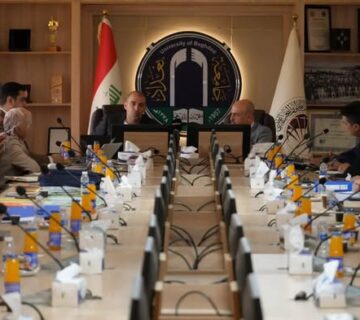
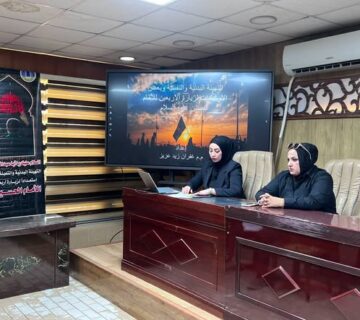
Under the patronage of Prof. Dr. Sameera Naji Khdim, Dean of the College of Science for Women, the Continuing Education Unit, in cooperation with the Department of Mathematics, organized a workshop entitled “The Role of Optimal Control Theory and Mathematical Modeling in Achieving the Sustainable Development Goals.” The workshop was presented by Dr. Nagham Musa Ni‘ma, Ms. Hadeel Hussein Naseef, and Ms. Zainab Abd Atiya. It was held in Abdul Hakim Hall and attended by a number of faculty members, staff, and female students.
The workshop aimed to introduce Optimal Control Theory as a branch of applied mathematics and engineering concerned with studying how the behavior of dynamic systems can be influenced and directed toward desired states through the use of appropriate control variables. Such approaches contribute to regulating system responses, improving performance, and enhancing operational efficiency.
The workshop addressed the importance of applying control theory in achieving the Sustainable Development Goals (SDGs), particularly in the fields of energy, environment, agriculture, healthcare, and transportation. In smart energy systems, control theory is used to regulate electricity consumption and minimize energy waste. It is also applied in industrial pollution monitoring systems through sensors and control mechanisms designed to monitor emissions and mitigate their environmental impacts. Furthermore, the workshop discussed its applications in smart agriculture, particularly through modern irrigation systems that regulate water quantities according to soil moisture levels. It also highlighted the role of control systems in sustainable transportation, where they are used to regulate traffic flow, reduce fuel consumption, and minimize emissions. In the medical field, control theory is employed in applications such as respiratory regulation devices and healthcare systems.
The workshop further explained the integrative relationship between mathematical modeling and control theory. Mathematical modeling contributes to understanding real-world systems, describing their dynamic behavior, and predicting potential problems, while control theory focuses on optimizing system performance, reducing errors, ensuring stability, and enhancing operational efficiency.
The workshop demonstrated that this integration is closely aligned with several Sustainable Development Goals, including SDG 3, which focuses on good health and well-being; SDG 6, concerning clean water and sanitation; SDG 7, relating to affordable and clean energy; SDG 9, concerning industry, innovation, and infrastructure; SDG 11, addressing sustainable cities and communities; and SDG 13, focusing on climate action. These applications play an effective role in promoting the efficient use of resources, reducing pollution, supporting scientific and technological innovation, and contributing to the development of a more sustainable future.