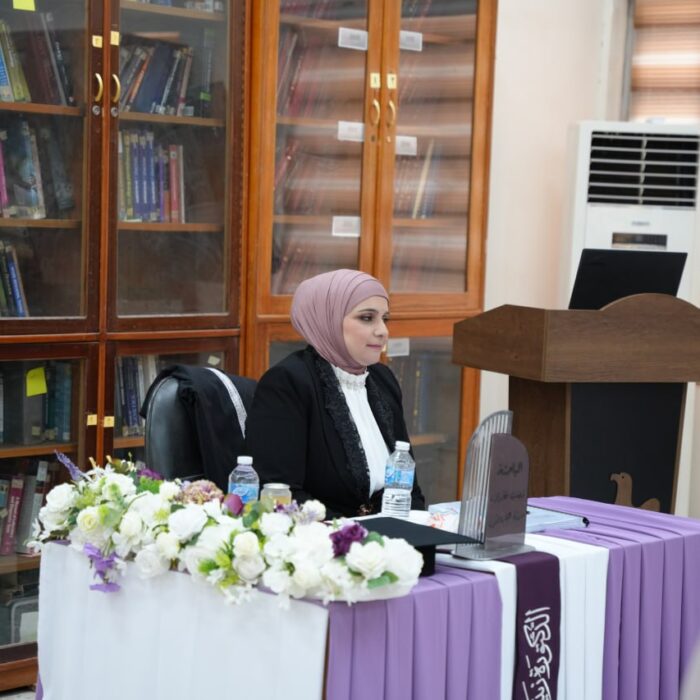
Dissertation Discussion
The College of Science for Women, University of Baghdad, examined the PhD dissertation entitled “Comparison of nanocomposites (nanoclay/metal oxides) biosynthesized for environmental applications”
submitted by the student( Zainab Fakhri Merzah Alqazwini)
Objectives of the Dissertation
The objectives of this study are summarized as follows:
-
- The dissertation aims to synthesize and compare hybrid nanocomposites based on titanium dioxide (TiO₂), copper oxide (CuO), and halloysite nanotubes (HNTs) using environmentally friendly green synthesis approaches. It also aims to investigate their structural, physical, and biological properties and evaluate their efficiency in environmental applications, particularly in water treatment through the removal of bacteria and heavy metals.
Content of the Dissertation
Dissertation also includes
- The dissertation included the green synthesis of titanium dioxide (TiO₂) nanoparticles using Swiss chard leaf extract with the assistance of Microwave Irradiation and Microjet Plasma techniques. A comparative study between the two methods was conducted, and the results demonstrated a high degree of similarity in the structural and physical properties of the synthesized nanoparticles, with no significant differences observed. The study also involved the synthesis of TiO₂@CuO nanoparticles and TiO₂/HNT and TiO₂@CuO/HNT nanocomposites, followed by their characterization using XRD, FESEM, TEM, FTIR, UV–Vis, and Zeta Potential techniques. The findings revealed the superior environmental performance of the TiO₂@CuO/HNT nanocomposite, which exhibited the highest antibacterial activity against Escherichia coli and Staphylococcus aureus, in addition to achieving highly efficient adsorption and removal of Pb²⁺, Cr³⁺, and Cd²⁺ ions, reaching 100% removal efficiency. These results demonstrate the effectiveness of this nanocomposite and its potential as a promising material for wastewater treatment applications.
Dissertation Recommendations
The most important recommendations which the study has come up with and the average obtained:
- The study recommended the synthesis of new TiO₂-based nanocomposites combined with various nanomaterials to enhance pollutant removal efficiency and antibacterial activity, as well as the development of hybrid structures based on halloysite nanotubes to improve water treatment performance. The study also recommended expanding future investigations to include the removal of additional pollutants and heavy metal ions, evaluating the effectiveness of the synthesized materials against antibiotic-resistant bacterial strains, assessing their environmental and biological safety, and exploring their potential applications in biomedical and healthcare fields.
Picture of the Committee members

53143