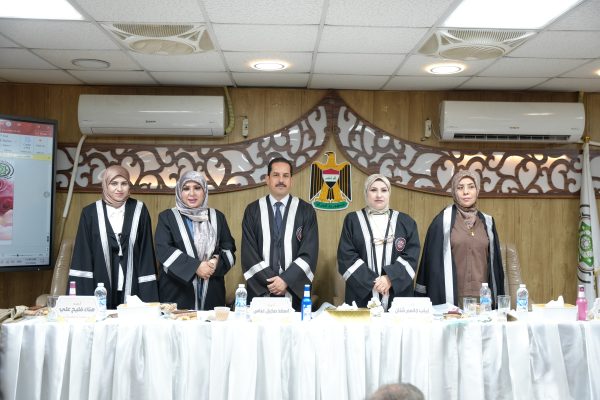
Master’s Discussion
College of Science for Women / University of Baghdad examined the thesis entitled (Preparation and Study of n-CdS/p-SnS Hetrojunction Nanocrystalline Thin Film for Photosensor Applications) of the student
Sabreen Sami Abdalhy
The n-CdS/p-SnS photosensor parameters were manufactured and studied by SILAR method with different cycles (25,50,75) cycles.
: In this study, CdS and SnS nanostructures were prepared using a simple and low-cost SILAR method and All physical properties were determined and examined, including optical properties Ultraviolet -Visible Spectroscopy (UV-VIS) and Photoluminescence examination (PL), encompassing structural properties X-ray diffraction (XRD), electrical properties direct current DC conductivity, Hall effect, and IV), and morphological properties Field Emission Scanning of Electron Microscope (FE-SEM) and Energy Dispersive X-Ray Spectroscopy (EDX).
A n-CdS/p-SnS junction was prepared using the SILAR method and with different immersion cycles (25,50,75 cycles) for photosensor applications.
Photosensors were evaluated under both dark and illuminated conditions with all parameters calculated, including responsivity, detectivity, quantum efficiency, rise time, and recovery time.
The best responsivity, the best detectivity, and the best quantum efficiency were obtained at the number of cycles (75 cycles), where the values of each of the
- Responsivity 53.018 mA/W53
- Detectivity 6.39×10⁹
- Quantitative Efficiency12.404%
the average obtained (Excellent)