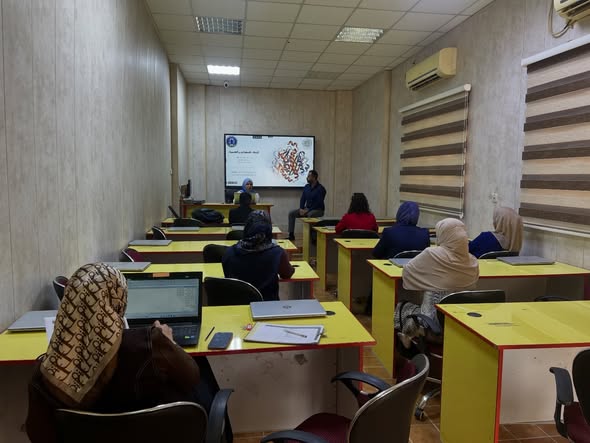

A workshop entitled “Artificial Intelligence and Chemistry” was organized by the Continuing Education Unit in collaboration with the Qualification and Employment Unit, under the patronage of the Dean of the College of Science for Women, Professor Dr. Sameera Naji Khdim. The workshop was presented by Dr. Safaa Sami Abdul Jabbar and Mr. Ahmed Najm Abd, and was attended by a number of faculty members, staff, and female students.
The workshop aimed to introduce the significance of artificial intelligence across various fields, while highlighting the rapid growth in this domain. It also addressed the historical development of artificial intelligence in the field of chemistry, beginning with rule-based systems. In this context, reference was made to one of the earliest models in the field: in 1964, the first expert system was developed by scientists at Stanford University to assist chemists in identifying unknown organic molecules through the analysis of mass spectra using the LISP programming language.
The workshop reviewed the stages of artificial intelligence development, including the emergence of machine learning and the introduction of open-source frameworks such as TensorFlow and PyTorch, which have significantly accelerated model development and enabled efficient analysis of chemical data. It further explored the contemporary phase of generative artificial intelligence, which has made it possible to design molecules *de novo*—including the creation of novel proteins—thereby opening broad prospects in drug discovery and materials development.
The workshop emphasized the importance of keeping pace with this rapid advancement and leveraging artificial intelligence technologies to support scientific research and the development of modern chemical applications. The session also featured active engagement, with discussions and contributions from attendees that were addressed by the organizers.