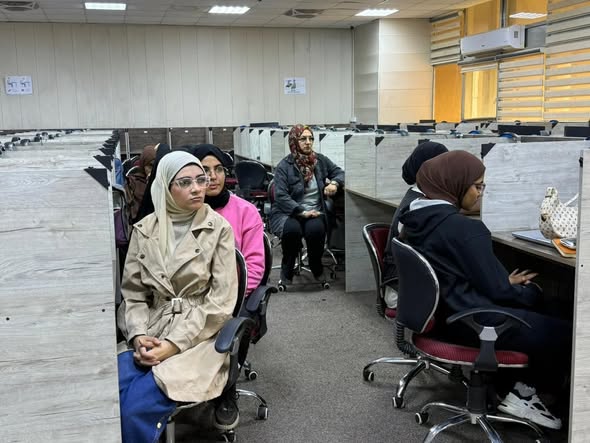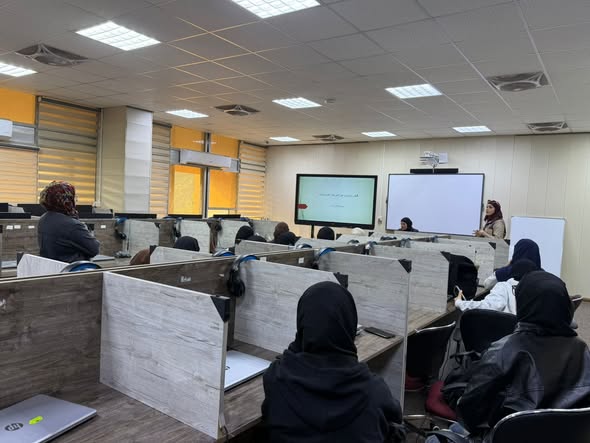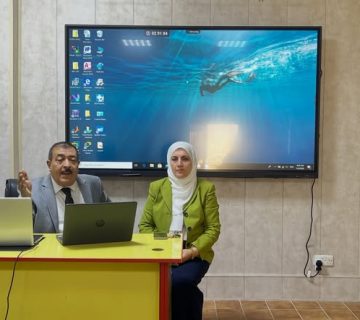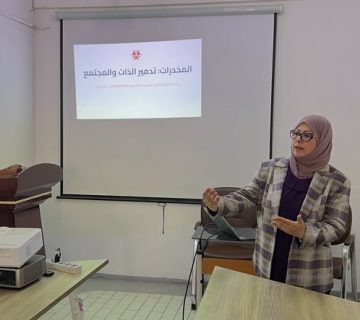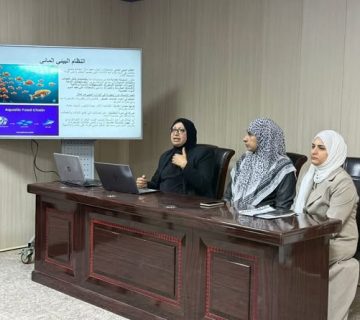
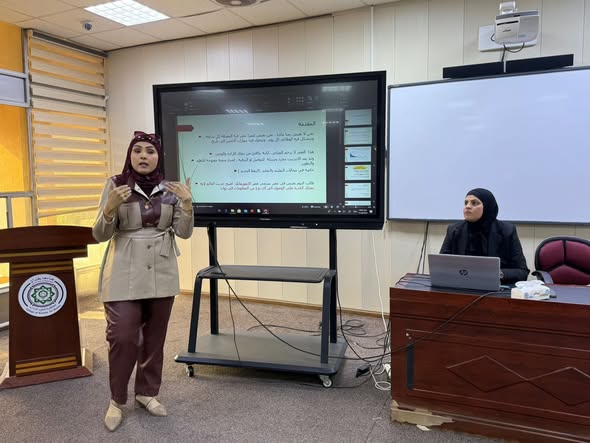
Under the patronage of the esteemed Dean of the College of Science for Women at the University of Baghdad, Prof. Dr. Sameera Naji Khdim , the Psychological Counseling and Educational Guidance Unit organized an educational scientific workshop titled “Challenges and Motivators of Studying in the Age of Informatics.” The workshop was presented by Dr. Wasan Mohsen Hassan and Dr. Ragaa Murayh Mohammed, with the attendance of faculty members and students of the department.
The workshop aimed to introduce the concept of the Age of Informatics as a phase characterized by a dramatic acceleration in the production of knowledge. It highlighted the historical transition from the Industrial Revolution, through the era of information and computing, to the current stage in which knowledge doubles within short time spans as a result of advancements in technology, artificial intelligence, and the Internet of Things.
The presenters explained that this rapid shift has reduced barriers to information and skills acquisition and has transformed the nature of employment. Consequently, students are now required to possess flexible skills, adaptability, and a commitment to continuous learning. They emphasized that this era “does not accommodate the complacent, but rewards those who possess determination and awareness.”
The workshop also addressed the role of the internet in reshaping the concept of studying, as it has become an open platform for self-learning and rapid access to information through credible sources such as YouTube and Google Scholar. It further highlighted the significance of Massive Open Online Courses (MOOCs), which enable students to learn beyond the confines of the classroom and to interact with instructors and peers globally through platforms such as Google Classroom and Zoom.
In conclusion, the workshop stressed the necessity of strengthening students’ digital literacy, guiding them toward constructive use of modern technologies, and developing their skills in alignment with labor-market demands, thus contributing to the formation of a generation capable of confidently confronting the challenges of the contemporary era.