Master’s Discussion
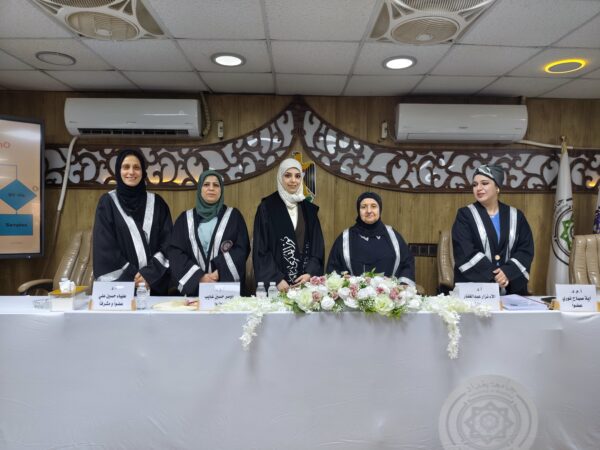
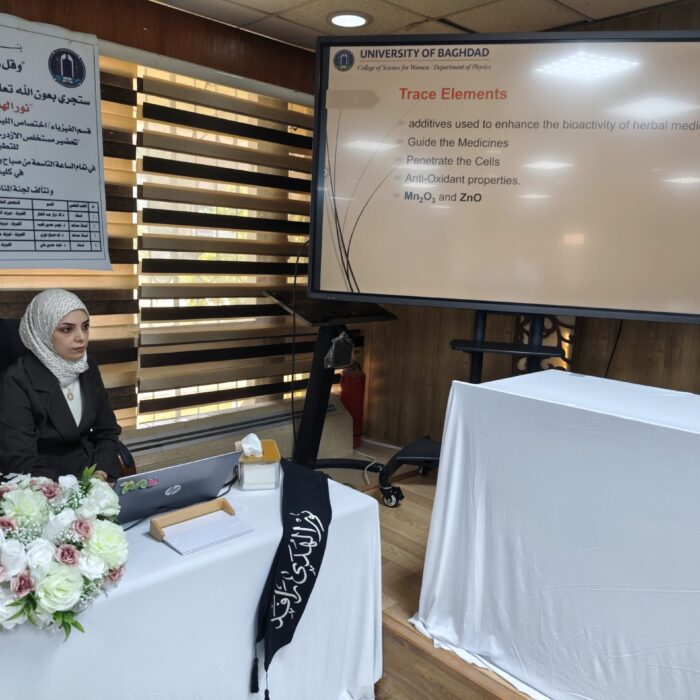
College of Science for Women/University of Baghdad examined and discussed the thesis entitled (Preparation of Azadharchta (Neem) Using Laser Effect for Medical Application) of the student Nooralhuda Rafid Hazim.
- The thesis aims to prepare Neem extract, in addition to studying the optical properties of the nano-extract to test it on cancerous liver cells (HepG2) for therapeutic efficacy and its effect on healthy liver cells, independently, and using metal oxides, zinc oxide (ZnO) and manganese trioxide (Mn2O3).
- The thesis also included the preparation of a nano-extract of neem leaves. This involved grinding the neem leaves using an electric grinder, then mixing the neem leaf powder with deionized water using a magnetic stirrer, without raising the solution’s temperature to avoid any chemical reaction that might alter its properties. The solution was then filtered, and the necessary laboratory tests were conducted to analyze its optical properties, chemical composition, and bonds, and to identify the active ingredients for medical applications. Zinc oxide (ZnO) and manganese trioxide (Mn2O3) nanoparticles were prepared using the laser ablation method (PLAL) with varying pulse counts. The best-performing zinc oxide (ZnO) nanoparticles were obtained using 600 pulses at a pulse energy of 300 mJ, while the best manganese trioxide (Mn2O3) nanoparticles were obtained using 600 pulses at a pulse energy of 600 mJ with an Nd: YAG laser. These nanoparticles were used as carriers for the active ingredients in the neem nano-extract and to aid in the penetration of cancer cells.Several samples of each element were prepared independently, and one sample containing all the elements together (neem, zinc oxide, and manganese oxide), and one sample containing (zinc oxide and manganese oxide). Several laboratory tests were carried out on the samples to determine the surface roughness, the sizes of the formed nanoparticles, the chemical bonds, the crystal structure, the components of the samples, their concentration, and their weight ratios.
Samples of the elements and compounds were tested on HepG2 liver cancer cells. The results showed that the compound containing neem nano-extract, zinc oxide (ZnO) nanoparticles, and manganese trioxide (Mn2O3) was able to destroy half of the cancer cells at a concentration of 4.942 µL. Cytotoxicity tests showed that the same compound was able to destroy half of the healthy cells within 24 hours at a concentration of 31.23 µL. The results indicate that the compound represents an effective treatment for HepG2 liver cancer at concentrations significantly lower than those that cause damage to healthy cells. The results also showed that zinc trioxide (Mn2O3) is an anticancer agent with very little effect on healthy cells. The toxicity and efficacy of zinc oxide depend on its concentration in the solution, which must be precisely calculated to ensure its effectiveness with minimal side effects
The most important recommendations that the study has come up with
1- The prepared compound and the method used preserved the properties of the essential components without any significant chemical changes and are considered a promising treatment for HepG2 liver cancer.
2 – Further research is needed to adjust the concentrations to achieve the optimal concentrations for maximum efficacy against cancer cells and minimal side effects on healthy cells.
3- Clinical trials should be conducted to develop the therapeutic formulation based on the findings of this thesis as part of future research
4- The compound produced in this thesis is a combination of readily available natural ingredients, making the treatment more cost-effective than traditional therapies and resulting in fewer side effects. It also incorporates the other therapeutic properties of Neem (Alexandrite) as an antimicrobial, antibacterial, and antiviral agent.
The average obtained was excellent.