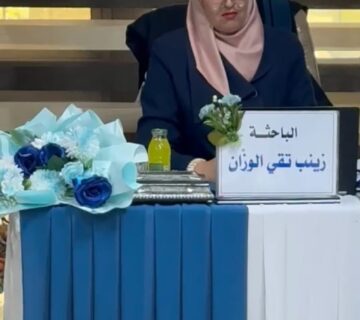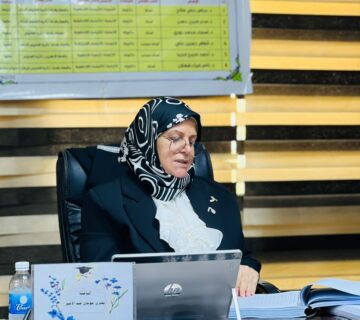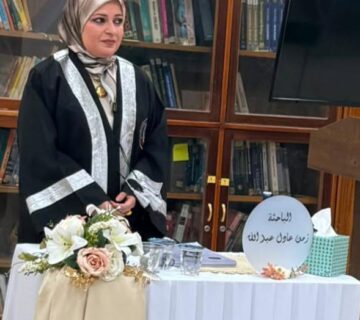
Master’s Discussion
The College of Science for women at the University of Baghdad discussed the master’s thesis entitled(Synthesis and Characterization of Multivalent Metal Ions Complexes with New Organic Ligands and Studying them Theoretically and Biologically).
By the student: Israa Rasheed Ghadhban
The objectives of this study are summarized as follows:
This study aims to prepare two new Schiff–Mannich base ligands derived from 1,3,4-thiadiazole and their complexes with some transition metal ions for the first, second, and third series. The study also includes the investigation of their structural and theoretical properties using HyperChem software, in addition to evaluating their thermodynamic stability through the calculation of heat of formation and binding energy, and comparing the theoretical results with the experimental results to verify the proposed structures of the complexes, as well as studying their biological activity against some bacterial and fungal isolates.
This study was conducted at the College of Science for Women, Department of Chemistry, University of Baghdad, during the period from November 2024 to February 2025. The prepared compounds were characterized using various spectroscopic and physical techniques, including elemental analysis (C.H.N), Fourier Transform Infrared Spectroscopy (FTIR), Ultraviolet–Visible Spectroscopy (UV–Vis), Nuclear Magnetic Resonance Spectroscopy (¹H-NMR and ¹³C-NMR), mass spectrometry, magnetic susceptibility, molar conductivity, and melting point determination, in addition to the evaluation of their biological activity. Some of these analyses were carried out outside the country, as well as in the laboratories of the College of Science at University of Baghdad and the College of Science at Mustansiriyah University.
The most important recommendations which the study has come up with and the average obtained:
1- Preparation of a new Schiff–Manch base derived from heterocyclic compounds such as (4,3,1-thiadiazole), and the preparation of new complexes of the Schiff–Manch base using other metal elements such as iron (Fe), cadmium (Cd), mercury (Hg), silver (Ag), etc., in addition to lanthanide and actinide metal elements.
2- Studying the biological activity of the prepared ligands and complexes using other types of bacteria and fungi.
3- Studying the anticancer activity of the prepared ligands and complexes against different types of cancer cells.
4- Using molecular docking programs to predict the possibility of the prepared compounds having antibacterial or anticancer activity.
5- Studying the ability of the prepared compounds to remove pollutant ions from water and benefiting from them in environmental treatments.
6- Studying the ability of the prepared compounds to inhibit corrosion and the possibility of their use in industrial applications.