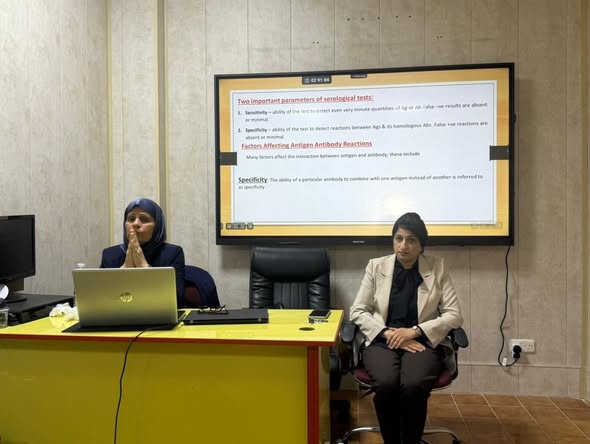
Under the patronage of the Dean of the College of Science for Women, Professor Dr. Sameera Naji Khdim, the Continuing Education Unit, in cooperation with the Department of Biology, organized a training course entitled “ELISA Test: Principles and Practical Applications on Different Types of Samples.” The course was presented by Dr. Ikhlas Mushrif Eidan, Dr. Zahraa Abdul Rahim Ahmed, and Dr. Maisam Blasim Naim in Abdul Hakim Hall, with the attendance of a number of faculty members, staff members, and students.
The course aimed to provide a comprehensive understanding of the Enzyme-Linked Immunosorbent Assay (ELISA), one of the most important immunological techniques used for the detection of antibodies or antigens in biological samples. The technique is widely recognized for its high sensitivity and specificity, making it a valuable tool in laboratory diagnostics and biomedical research.
The course included a detailed explanation of the working principle of the ELISA test, which is based on the specific interaction between an antigen and an antibody. The assay utilizes an enzyme-linked detection system that produces a measurable colorimetric signal, enabling the identification and quantification of the target substance. Participants were also introduced to the different types of ELISA assays, including Direct ELISA, Indirect ELISA, Competitive ELISA, and Sandwich ELISA, with a discussion of the characteristics, applications, and distinctions of each method.
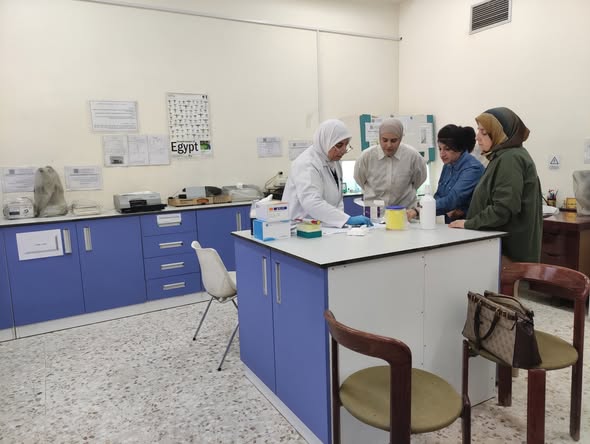
Furthermore, the course covered the practical procedures involved in performing the assay, beginning with the preparation of various sample types, such as serum, plasma, saliva, and tissue specimens. The presenters explained the subsequent steps, including reagent addition, incubation, reaction development, and the accurate reading and interpretation of results.
The course also highlighted the diverse applications of ELISA in multiple fields, including the diagnosis of infectious diseases caused by viruses and bacteria, hormone detection, monitoring of immune-related disorders, and its use in scientific research. In addition, the assay’s role in the analysis of environmental and food samples was discussed.
The training session witnessed active participation and engagement from the attendees through questions and discussions addressing the practical aspects of the technique. This interaction contributed significantly to strengthening participants’ practical understanding and enhancing their laboratory skills.
At the conclusion of the course, the organizers emphasized the importance of such training programs in supporting the competencies of students and academic staff and in keeping pace with modern developments in immunological analysis and laboratory diagnostics.
It is noteworthy that this course contributes to the achievement of two United Nations Sustainable Development Goals (SDGs): Goal 3 – Good Health and Well-Being, and Goal 4 – Quality Education.