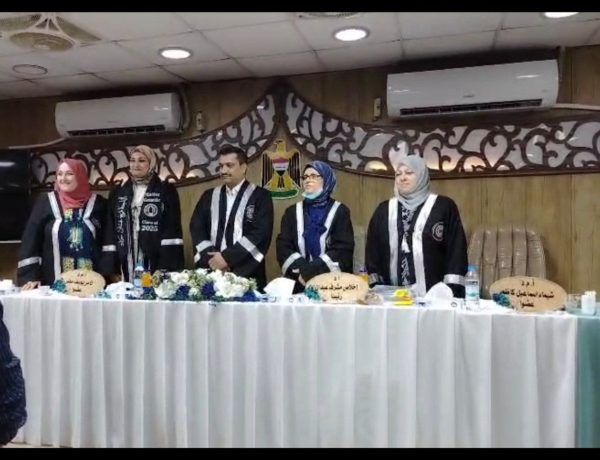
Master’s Discussion
The College of Science for Women / University of Baghdad examined the thesis entitled (Association between Pseudomonas aeruginosa cup genes and human integrin beta one gene in infected patients) of the student (Farah Ghassan Jawad), in Partial Fulfilment of the Requirements for the Degree of Master in Biology / Genetics.
The thesis aims to evaluate gene expression and genetic polymorphism of human ITGB1 with gene expression of cup genes in Pseudomonas aeruginosa patients infected with it.
The study involved investigating gene expression and polymorphisms of the human ITGB1 gene and Cup genes in Pseudomonas aeruginosa isolated from patients with burns, wounds, and diabetic foot ulcers. This study was conducted in Baghdad and included 110 skin swabs and blood samples from the same patients. The haplotype of the gene was also studied for 22 patients infected with Pseudomonas aeruginosa compared to 15 healthy individuals.
The study concluded that there is a relationship between the genotypes of several single nucleotides in the ITGB1 gene and increased susceptibility to Pseudomonas aeruginosa infection. A relationship was also found between gene expression of the ITGB1 gene and increased susceptibility to Pseudomonas aeruginosa infection, with upregulation in gene expression of the ITGB1 gene with 1.6 fold compared to the healthy control group. Furthermore, the study found a close relationship between the gene expression of the cup genes in Pseudomonas aeruginosa and the biofilm phenotype. The cupA and cupB genes showed upregulation in gene expression in strong, moderate, and weak biofilm types, reflecting their essential role in biofilm formation. Conversely, the cupC and cupD genes showed lower gene expression in all biofilm types, reflecting the increased ability of bacteria to form biofilms with increased gene expression of the cup gene, and consequently, increased adhesion to the integrin unit.
Excellent